
Every article in this series eventually arrives at the same question. This is where all of it comes together into one decision framework.
Executive Summary. Repair, retrofit, and replace are three distinct engineering responses to a damaged or aging industrial asset, and the right choice depends on a structured evaluation of mechanical condition, damage extent, control system status, and cost — not on assumption, asset age alone, or which option seems simplest at the time. This article brings together the assessment principles, decision factors, and recovery frameworks covered throughout SRT's engineering knowledge base into one unified decision structure, and serves as the closing reference point for the full Machine Recovery series.
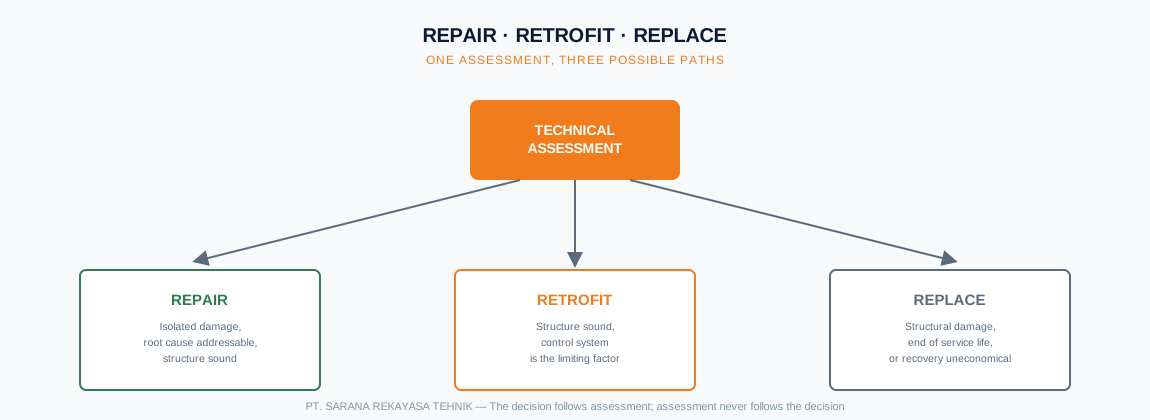
Three Distinct Options, Not One Sliding Scale
Repair, retrofit, and replace are sometimes treated as points on a single scale from "cheap and minimal" to "expensive and complete" — but they answer different engineering questions, and conflating them leads to poor decisions.
REPAIR
Restores a damaged component or system back to its prior functional condition. Addresses damage, not obsolescence.
RETROFIT
Modernizes a mechanically sound machine's control, automation, or performance capability. Addresses obsolescence, not necessarily damage.
REPLACE
Substitutes the entire asset. Appropriate when neither repair nor retrofit is technically or economically justified.
A single project can combine more than one — a machine recovering from flood damage (repair) may also present the opportunity to modernize an outdated control system (retrofit) discovered during the same assessment, as covered in Flood-Damaged Electric Motor Recovery → and PLC & Servo Automation Retrofit →.
Why This Decision Is Often Made Incorrectly
The single most common mistake, running through nearly every scenario covered in this series, is reaching a repair-retrofit-replace decision before completing a structured technical assessment. This happens in both directions:
- Premature replacement. An asset is scrapped based on visual impression or age alone, when assessment would have shown it recoverable — a costly and often unnecessary outcome, particularly for equipment with long replacement lead times.
- Repair without addressing root cause. A failure symptom is repaired — a bearing replaced, a component swapped — without investigating why it failed, leaving the underlying condition to cause recurrence. This is the central theme of Root Cause Analysis: A Practical Approach →.
Both mistakes share the same root: substituting assumption for assessment.
The Unified Decision Framework
Bringing together the assessment principles covered across this series, the repair-retrofit-replace decision should weigh the following factors together:
| Factor | What It Determines |
|---|---|
| Mechanical/structural condition | Whether the underlying platform is sound enough to justify repair or retrofit investment — determined by measurement, not visual impression |
| Extent and root cause of damage | Whether the damage is isolated and addressable, or reflects a systemic condition likely to recur — see Root Cause Analysis |
| Control system condition | Whether obsolescence in PLC, servo, or safety systems — independent of physical damage — is the actual limiting factor, pointing toward retrofit (see Automation Retrofit) |
| Itemized cost comparison | Recovery Cost Estimation for repair/retrofit, built component-by-component, compared against realistic replacement cost — not a percentage-of-value estimate (see RCE Principle) |
| Lead time | Replacement lead time for the specific asset, which can materially favor recovery even where replacement cost is comparable |
| Remaining service life | Whether the asset was recently installed or already near end of expected service life, independent of the current damage event |
| Safety and criticality | Whether the asset's role — structural, pressure-containing, safety-critical — warrants more conservative treatment |
| Documentation availability | Whether OEM support or documentation exists, or reverse engineering would be required to support repair (see Reverse Engineering) |
When Each Option Is the Right Choice
Repair is favored when:
- Damage is isolated, with a clearly identified and addressable root cause
- Structural/mechanical condition remains within acceptable margin after assessment
- Itemized recovery cost is meaningfully lower than replacement, accounting for lead time
Retrofit is favored when:
- The mechanical platform is sound, but control, automation, or safety systems have become the limiting factor
- Component obsolescence (unsupported PLC, discontinued parts) creates ongoing reliability risk independent of any specific damage event
- Modernization would meaningfully extend service life at a fraction of full replacement cost
Replace is favored when:
- Structural or core damage is extensive, or assessment shows remaining margin is inadequate
- The asset is already near end of expected service life, independent of the current event
- Repeated failure risk remains high even after repair, due to unresolved systemic or design factors
- A production requirement has evolved beyond what the existing asset — even retrofitted — can reasonably meet, pointing toward a special purpose machine instead (see Special Purpose Machine vs Off-the-Shelf →)
Where Insurance and Documentation Intersect This Decision
Where the triggering event is the subject of an insurance claim, the repair-retrofit-replace decision and the claims process are closely linked — root cause findings often determine claim defensibility, and the recovery cost estimate underlying a repair decision should meet the same evidentiary standard covered in Insurance Engineering Explained → and Loss Adjuster's Guide to Machinery Claims →. Evidence preserved in the immediate aftermath of a damage event, as covered in Damage Assessment Checklist → directly supports the quality of this entire decision process.
Key Takeaways
- Repair, retrofit, and replace address different problems — damage, obsolescence, and end-of-life respectively — and should not be treated as one sliding scale.
- The decision should never precede structured technical assessment — this is the single most consistent principle across every damage type and scenario in this series.
- Cost comparison should be itemized and specific to the actual case, not based on a general assumption or percentage of asset value.
- A single project frequently combines repair or recovery work with a retrofit opportunity discovered during the same assessment.
- Root cause resolution matters regardless of which option is chosen — repairing or replacing without addressing why the original failure occurred risks recurrence.
Facing a repair, retrofit, or replace decision for damaged or aging industrial equipment? SRT's engineering team can conduct the structured assessment this decision depends on.
Frequently Asked Questions
What is the difference between repair, retrofit, and replace?
Repair restores a damaged component to functional condition. Retrofit modernizes a mechanically sound machine's control or performance capability. Replace substitutes the entire asset with a new one — appropriate when repair or retrofit is not technically or economically justified.
How do you decide between repairing and replacing a machine?
Based on technical assessment findings covering mechanical condition, extent of damage, remaining structural margin, control system condition, and a comparison of itemized recovery cost against replacement cost and lead time — not a single factor considered in isolation.
Is it always cheaper to repair than replace?
No. This depends entirely on the specific damage extent, the asset's remaining service life, and replacement lead time — a structured Recovery Cost Estimation compared against replacement cost is needed to answer this for a specific case, not a general assumption.
What is the most common mistake in the repair vs replace decision?
Making the decision before completing technical assessment — either replacing an asset that assessment would show to be recoverable, or repairing a symptom without addressing the root cause, risking recurrence regardless of repair quality.
When does retrofit make more sense than either repair or replacement?
When the mechanical platform is sound but the control, automation, or safety systems have become the limiting factor — retrofit captures the value of the proven mechanical structure while addressing what has actually become obsolete.
The Complete Machine Recovery Series
The starting point for the full recovery decision framework.
How technical assessment supports machinery insurance claims.
Engineering signs pointing toward retrofit over replacement.
How these three interventions differ in scope and outcome.
Recovery levels applied to a real assessment scenario.
Building a defensible, itemized Recovery Cost Estimate.
Distinguishing root cause from symptom and failure mechanism.
When the control system, not the machine, is the limiting factor.
Evaluating technical evidence in a claims context.
When neither recovery nor standard replacement fits.
Reconstructing specifications when documentation is gone.
What to gather, and when, to build a defensible claim.
Reverse engineering, design, PLC programming, and automation.
Machining, fabrication, spare parts, and special purpose machines.