
Corrosion rarely announces itself with a single dramatic event — which is exactly why it demands more disciplined measurement, and often faces more scrutiny at claims time, than damage from a sudden incident.
Executive Summary. Corrosion is fundamentally different from acute damage events like flood or fire — it progresses gradually, can be difficult to detect until structural margin is significantly consumed, and is frequently treated differently under insurance policies as a result. This article covers the common corrosion mechanisms affecting industrial equipment, how corrosion damage is properly assessed through measurement rather than visual impression, the recovery levels available depending on remaining structural margin, and why corrosion's gradual nature creates distinct engineering and insurance considerations compared to sudden damage.
Why Corrosion Is Different From Sudden Damage Events
Unlike flood or fire damage, which occur at an identifiable point in time and typically prompt immediate response, corrosion is a progressive process — often unfolding over months or years, frequently unnoticed until inspection, a failure, or a scheduled shutdown reveals its extent. This has two significant consequences for how corrosion should be handled.
First, engineering assessment must rely on quantified measurement — wall thickness, pit depth, material condition — rather than a single visual inspection, since the true structural significance of corrosion is rarely apparent to the eye alone. Second, corrosion's gradual nature places it in a different category from an engineering and insurance perspective than a sudden incident, a distinction covered further below.
Common Corrosion Mechanisms in Industrial Equipment
| Mechanism | Characteristics |
|---|---|
| Uniform corrosion | Even material loss across a surface — comparatively predictable and straightforward to measure and project |
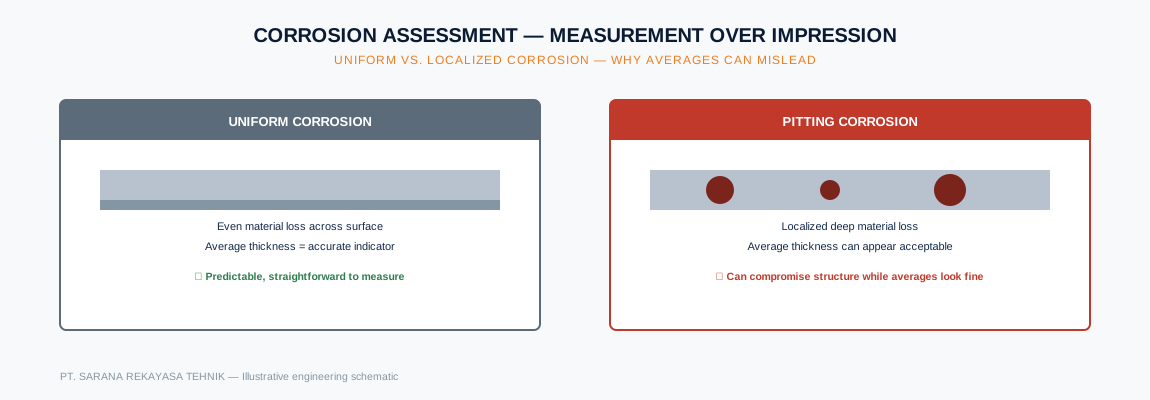
| Pitting corrosion | Localized, concentrated material loss — can compromise structural or pressure-containing integrity while average wall thickness still appears acceptable |
| Crevice corrosion | Occurs in confined spaces (gaskets, joints, under deposits) where stagnant conditions accelerate localized attack |
| Galvanic corrosion | Accelerated corrosion where dissimilar metals are in contact in the presence of an electrolyte |
| Erosion-corrosion | Combined mechanical wear and corrosive attack, common in high-velocity fluid flow applications |
| Stress corrosion cracking | Cracking under the combined effect of tensile stress and a corrosive environment — a particularly serious mechanism given its potential for sudden, brittle failure |
The Corrosion Assessment Process
- Visual inspection and morphology identification. Determining which corrosion mechanism(s) are present, informing which measurement techniques and locations require particular attention.
- Wall thickness measurement. Typically via ultrasonic testing (UT), measuring remaining material thickness at multiple points, with particular attention to areas showing pitting or localized attack rather than relying on average readings alone.
- Comparison against original design specification. Remaining thickness is evaluated against the component's original design wall thickness and corrosion allowance, not against an assumed generic minimum.
- Structural or pressure calculation, where applicable. For pressure-containing or load-bearing components, remaining thickness is used in engineering calculation to confirm continued safe operating margin — not assumed acceptable based on thickness alone.
- Root cause and environmental review. Identifying the underlying driver — coating failure, inadequate material selection for the environment, process chemistry change, or inadequate maintenance — informs both the recovery approach and prevention of recurrence.
- Progression rate estimation, where historical data exists. Comparison against prior inspection records, if available, helps estimate corrosion rate and inform remaining service life projection.
Recovery Levels for Corrosion-Affected Equipment
| Level | Typical Scope | Indication |
|---|---|---|
| Surface Treatment | Cleaning, surface preparation, coating restoration | Corrosion limited to surface/coating, minimal material loss, structural margin intact |
| Localized Repair | Weld repair or localized material replacement at specific corroded areas | Isolated pitting or localized loss, remainder of component within acceptable margin |
| Component Replacement | Full replacement of the corroded component or section | Widespread material loss below acceptable margin, structural or pressure-containing role |
| Full Asset Replacement | Replacement of the entire equipment item | Corrosion extent and structural role make component-level recovery impractical or uneconomical |
This is directly parallel to the recovery-level framework applied to other damage causes, detailed in Flood-Damaged Electric Motor Recovery → — the specific criteria differ, but the principle of assessment-determined scope, rather than assumption, applies equally.
Corrosion and Insurance: An Important Distinction
From an engineering perspective — not a legal or policy determination:
Corrosion's gradual nature means it is frequently treated differently under industrial insurance policies compared to sudden events. Many policies include exclusions or limitations for gradual deterioration, wear and tear, or damage arising from inadequate maintenance — categories that corrosion can fall into depending on its specific cause and progression. Whether a specific instance of corrosion damage is covered under a specific policy is a contractual and legal question outside the scope of engineering assessment.
What engineering assessment can establish is the technical distinction between corrosion resulting from a specific, identifiable triggering event (for example, accelerated corrosion following chemical exposure from an operational incident) versus long-term progressive corrosion consistent with normal environmental exposure and maintenance history. This distinction — sudden-triggered versus gradual — is often the technical question that determines how a claim is evaluated, even though the coverage conclusion itself remains a policy matter. This connects to the broader framework covered in Insurance Engineering Explained →.
Recovery vs. Replacement: Corrosion-Specific Factors
- Remaining structural margin. The core technical factor — how much of the component's original design margin remains relative to minimum required thickness.
- Structural or safety criticality. Pressure vessels, load-bearing structures, and safety-critical components warrant more conservative treatment than non-critical equipment.
- Progression rate. Where corrosion rate can be estimated, projected future condition — not just current condition — informs whether repair provides adequate remaining service life.
- Root cause resolution. Repairing corrosion damage without addressing its underlying cause (coating failure, environmental exposure, material mismatch) risks recurrence regardless of repair quality.
Key Takeaways
- Corrosion assessment depends on quantified measurement — wall thickness, pit depth — not visual impression, since true structural significance is rarely visible directly.
- Pitting and stress corrosion cracking can compromise structural integrity while overall measurements still appear acceptable — localized inspection matters as much as coverage.
- Recovery scope should be determined by remaining structural margin against original design specification, not assumed based on corrosion's visible extent.
- Corrosion's gradual nature creates distinct insurance considerations compared to sudden damage events — this is a policy question informed by, but distinct from, engineering findings.
- Addressing root cause (coating, environment, material selection) is necessary to prevent recurrence, independent of repair quality.
Have corrosion-affected equipment and need a structural assessment? SRT's engineering team can conduct measurement-based corrosion assessment and recovery scope determination.
Frequently Asked Questions
How is corrosion damage assessed on industrial equipment?
Through visual inspection to identify corrosion type and extent, wall thickness measurement (typically ultrasonic testing) to quantify material loss, and where structural integrity is a concern, engineering calculation against the component's original design margin.
Is corrosion damage covered by insurance?
This depends on the specific policy and circumstances, but corrosion is frequently treated differently from sudden events like flood or fire, since gradual corrosion can fall under wear-and-tear or maintenance exclusions common in industrial policies — this is a policy interpretation question, not an engineering one.
What is the difference between pitting corrosion and uniform corrosion?
Uniform corrosion removes material evenly across a surface and is comparatively predictable, while pitting corrosion concentrates material loss into localized points, which can compromise structural integrity while overall average wall thickness still appears acceptable.
Can corroded equipment still be safely repaired?
Often yes, depending on remaining wall thickness relative to the engineering design margin and the component's structural or pressure-containing role — this determination should be based on measurement and calculation, not visual impression alone.
How can corrosion be distinguished from other causes of metal loss or damage?
Through visual examination of corrosion morphology, material testing where the mechanism is unclear, and review of the component's environmental exposure and maintenance history — since visually similar damage can sometimes result from mechanical wear or erosion rather than corrosion alone.
Related Reading
The broader recovery decision framework this article extends.
The same recovery-level framework applied to a different damage cause.
How sudden vs. gradual cause distinctions factor into claims assessment.
Identifying why corrosion occurred, not just where.
Part of the complete guide: What is Machine Recovery? A Complete Guide →