
These three terms get used interchangeably in casual conversation — but they describe fundamentally different scopes of work, with different cost, timeline, and outcome implications.
Executive Summary. Repair, retrofit, and remanufacturing are distinct engineering interventions, differentiated primarily by scope and the specification outcome they target. Repair restores specific identified faults to original working condition. Retrofit upgrades selected systems beyond original specification, most commonly control and automation. Remanufacturing is a complete, systematic rebuild of the entire machine to like-new condition, regardless of which individual components had actually failed. Understanding which applies to a given situation matters directly for budgeting, timeline expectations, and the warranty an asset owner should reasonably expect.
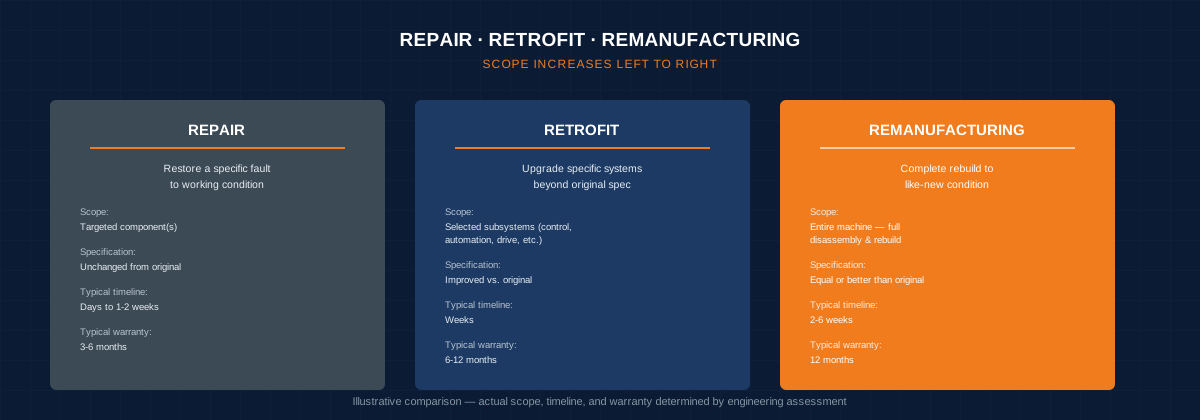
Repair — Restoring a Specific Fault
Repair is the most targeted of the three interventions. It addresses one or more identified faults — a failed bearing, damaged wiring, a cracked housing — and restores the affected component or subsystem to its original working condition. The rest of the machine remains untouched, and the specification does not change: a repaired machine performs as it did before the fault occurred, not better.
Repair is appropriate when damage is limited and well-defined, and when a technical assessment confirms the remainder of the machine remains in serviceable condition.
Retrofit — Upgrading Beyond Original Specification
Retrofit involves upgrading specific systems — most commonly control, automation, or drive systems — to a specification better than the machine's original configuration. Unlike repair, retrofit is not necessarily a response to failure; it is often undertaken on a functioning machine to address obsolescence, improve precision, or extend useful service life.
The scope of a retrofit is broader than a single-component repair but still limited to selected subsystems, not the entire machine. For a detailed look at when retrofit is the right call, see 5 Signs Your Machine Needs a Retrofit →.
Remanufacturing — Complete Rebuild to Like-New Condition
Remanufacturing is categorically different from both repair and retrofit in scope. It is a complete, systematic rebuild of the entire machine: full disassembly, comprehensive inspection of every component regardless of whether it has failed, replacement of worn parts, surface reconditioning, precision reassembly, and thorough performance testing.
The defining characteristic of remanufacturing is that it is not driven by which specific components have failed — it is driven by the cumulative condition of the machine as a whole. A remanufactured machine is intended to perform at a level equal to or exceeding its original condition, with a correspondingly extended service life.
Side-by-Side Comparison
| Repair | Retrofit | Remanufacturing | |
|---|---|---|---|
| Scope | Specific identified fault(s) | Selected subsystems | Entire machine |
| Trigger | A component failure | Obsolescence or performance limitation | Cumulative wear across the machine |
| Specification outcome | Same as original | Better than original (targeted systems) | Equal to or better than original (whole machine) |
| Typical timeline | Days to 1–2 weeks | Weeks | 2–6 weeks |
| Typical warranty | 3–6 months | 6–12 months | 12 months |
Timelines and warranty periods are typical ranges — actual figures depend on machine type, condition, and scope confirmed during assessment.
How the Decision Is Actually Made
In practice, the choice between repair, retrofit, and remanufacturing is not made by preference — it follows from a structured technical assessment. An isolated, well-defined fault on an otherwise sound machine points toward repair. A functional limitation on a machine that is otherwise mechanically fit points toward retrofit. Broad wear, degraded tolerances across multiple systems, or an accumulation of deferred maintenance typically points toward remanufacturing as the option that delivers durable value rather than a series of repeated repairs.
This decision sits within the broader repair-vs-retrofit-vs-replace framework covered in Repair vs Retrofit vs Replace: An Engineering Decision Framework → — remanufacturing typically enters that framework as an extended form of repair/retrofit, evaluated against full replacement using the same Recovery Cost Estimation principles.
Key Takeaways
- Repair, retrofit, and remanufacturing differ primarily in scope — from a specific fault, to selected subsystems, to the entire machine.
- Remanufacturing is defined by the cumulative condition of the whole machine, not by which individual components have failed.
- Retrofit is often combined with remanufacturing, since full disassembly creates a practical opportunity to upgrade control or automation systems at the same time.
- Which intervention applies should follow from a structured technical assessment, not from assumption or preference.
Frequently Asked Questions
Is remanufacturing the same as a major repair?
No. A major repair still targets specific identified faults, even if extensive. Remanufacturing is a complete, systematic rebuild of the entire machine — every component is inspected and either restored or replaced, regardless of whether it had failed.
Can a machine be retrofitted and remanufactured at the same time?
Yes, this is common. A remanufacturing project is often a practical opportunity to incorporate a retrofit — such as upgrading a control system — since the machine is already fully disassembled for inspection.
Does remanufacturing cost more than repair?
Generally yes, because the scope is the entire machine rather than specific components. Whether remanufacturing is cost-justified compared to repair or replacement depends on the machine's condition, criticality, and remaining service life — this is what a Recovery Cost Estimation is designed to establish.
How do I know if my machine needs repair, retrofit, or remanufacturing?
This depends on the extent and nature of the issue: an isolated fault typically calls for repair, a functional limitation (e.g., outdated control system) calls for retrofit, and broad, cumulative wear across the whole machine is what typically justifies remanufacturing. A structured technical assessment determines which applies.
Related Reading
How to recognize when retrofit — not repair — is the right call.
The complete engineering decision framework this article feeds into.
How recovery scope and cost are built from component-level evidence.
The complete guide this article is part of.
Part of the complete guide: What is Machine Recovery? A Complete Guide →
Explore the service: Machinery Repair & Recovery →