Why "what broke" is the wrong question — and why "why did it fail" is the one that actually determines whether your claim, your maintenance budget, and your next failure are handled correctly.
Executive Summary. Root Cause Analysis (RCA) is a structured engineering investigation method used to determine why a machine or system failed — not merely how it broke. For industrial machinery, RCA distinguishes the root cause from contributing factors and surface symptoms, using physical evidence, operating history, and engineering reasoning rather than assumption. In an insurance context, RCA is often the deciding factor in whether a claim is defensible: a report that identifies a mechanism ("bearing seized") without establishing why it seized is technically incomplete and commercially vulnerable. This article sets out what RCA actually involves, the methodologies commonly applied to industrial machinery failure, and how RCA connects to technical assessment, insurance claims, and Recovery Cost Estimation.
What Root Cause Analysis Actually Means
Root Cause Analysis (RCA) is a structured method of investigation used to determine the underlying reason a failure occurred — as distinct from the immediate, visible mechanism of failure. This distinction matters more than it may first appear.
Consider a common example: a motor bearing seizes and the motor fails. "The bearing seized" describes the failure mechanism — it is observable, physical, and relatively easy to confirm. It is not, on its own, a root cause. The root cause is whatever condition caused that bearing to seize in the first place: contamination from a compromised seal, inadequate lubrication interval, misalignment introducing abnormal load, or a design limitation under the actual operating conditions. Each of these possible root causes leads to a different corrective action — and, in an insurance context, potentially a different claim outcome.
RCA, properly applied, is the discipline of not stopping the investigation at the first visible answer.
Root Cause vs. Symptom vs. Failure Mechanism
These three terms are frequently used interchangeably in casual discussion, but they describe different things, and confusing them is one of the most common weaknesses in an informal failure report.
| Term | What it describes | Example |
|---|---|---|
| Symptom | The observable effect of the failure — what is noticed first | Motor stopped running; abnormal noise; production line halted |
| Failure Mechanism | The physical or technical process by which the component failed | Bearing seized due to inadequate lubrication film |
| Root Cause | The underlying condition, decision, or system gap that allowed the failure mechanism to occur | Lubrication interval was not adjusted after a documented increase in ambient temperature and load |
A report that documents only the symptom and mechanism — without tracing back to the root cause — has described what happened without explaining why it happened. This is a critical gap when the findings are meant to support a repair-versus-replace decision, a maintenance program correction, or an insurance claim.
Why Root Cause Analysis Matters for Industrial Machinery
Beyond satisfying curiosity about what went wrong, RCA serves several concrete engineering and business purposes:
- Preventing recurrence. A repair that addresses only the failure mechanism (replacing the bearing) without addressing the root cause (correcting the lubrication interval) leaves the underlying condition unresolved — the same failure is likely to recur.
- Informing the recovery strategy. Whether a component should be repaired, retrofitted, or replaced often depends on whether the root cause is a one-off event or a systemic condition affecting other equipment.
- Supporting claims and technical assessment. A root cause finding backed by evidence is far more defensible — to an insurer, an auditor, or an internal stakeholder — than a conclusion based on visual inspection alone.
- Building institutional knowledge. Documented RCA findings, over time, become a reference for recognizing similar failure patterns across a facility's asset base.
The RCA Investigation Process
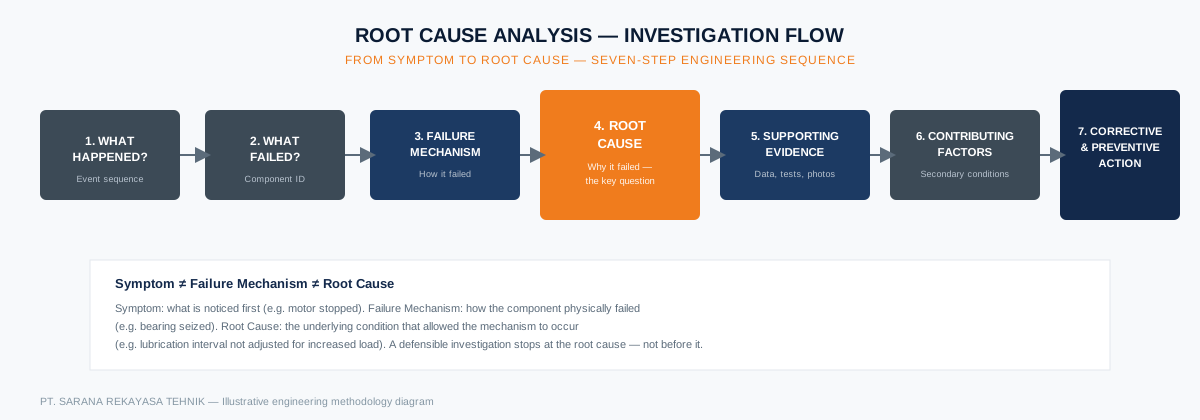
A structured RCA investigation typically proceeds through the following stages:
1. What Happened?
Establish the factual sequence of events: when the failure was noticed, under what operating conditions, and what immediate actions were taken. This stage is purely descriptive — no conclusions yet.
2. What Failed?
Identify the specific component or system that failed, confirmed through physical inspection rather than assumption based on symptoms alone.
3. How Did It Fail? (Failure Mechanism)
Determine the physical or technical mechanism of failure — mechanical fatigue, electrical insulation breakdown, corrosion, overheating, contamination, or a combination. This typically requires disassembly, physical examination, and in some cases material or electrical testing.
4. Why Did It Fail? (Root Cause)
Trace the failure mechanism back to its underlying cause. This is the step most often skipped or abbreviated in informal investigations, and it is where structured methodologies (covered below) provide the most value.
5. What Evidence Supports the Conclusion?
Every root cause conclusion should be traceable to specific physical evidence, test results, operating records, or documented observations — not inference alone. Photographs, measurements, and retained failed components form part of this evidentiary record.
6. What Are the Contributing Factors?
Failures are frequently the result of more than one contributing condition. A bearing seizure might have a primary root cause (inadequate lubrication interval) alongside a contributing factor (elevated ambient temperature that accelerated the effect). Identifying contributing factors, not just a single root cause, produces a more complete and more defensible investigation.
7. Corrective and Preventive Action
The investigation concludes with recommended corrective action (addressing this specific failure) and preventive action (addressing the underlying condition across similar equipment or future operation).
Common RCA Methodologies
Several structured methodologies are commonly applied in industrial failure investigation. The appropriate method depends on the complexity of the failure and the evidence available — no single method is universally correct for every case.
- 5 Why Analysis. A simple, iterative technique of repeatedly asking "why" to move from symptom toward root cause. Effective for straightforward, single-cause failures; less effective for complex failures with multiple interacting factors.
- Fishbone (Ishikawa) Diagram. A visual technique that organizes potential contributing causes into categories (e.g., Machine, Method, Material, Manpower, Environment) to ensure a broad range of possible causes is considered before narrowing to the root cause.
- Fault Tree Analysis. A top-down, logic-based method that maps the combinations of conditions that could lead to a specific failure event, useful for complex systems with multiple potential failure paths.
- Failure Mode Analysis. Focuses on systematically characterizing how a component can fail (its failure modes) and the effects of each, often used in combination with physical or material testing.
Root Cause Analysis in the Context of Insurance Claims
This is where RCA and insurance engineering intersect directly. Insurance policies covering industrial machinery typically include specific exclusion clauses — for example, damage arising from normal wear and tear, inadequate maintenance, or a pre-existing defect. Whether a claim falls inside or outside these exclusions is, from an engineering perspective, precisely the question that RCA is designed to answer.
A claim supported only by a description of the failure mechanism ("the winding insulation failed") leaves open the question of why — was it a sudden, covered event (e.g., a voltage surge from an external cause), or a gradual, potentially excluded condition (e.g., long-term insulation degradation from inadequate maintenance)? Without a root cause finding backed by evidence, an adjuster or insurer has limited technical basis to conclude either way — and the claim is correspondingly more vulnerable to dispute, reduction, or rejection.
For this reason, RCA conducted as part of a technical assessment for an insurance claim should be:
- Independent — conducted by a party without a direct interest in the claim outcome, strengthening the credibility of the findings.
- Evidence-based — every conclusion traceable to specific physical evidence or test results, not inference alone.
- Methodologically transparent — the investigation approach and reasoning documented, not just the conclusion.
- Timely — conducted as early as practical after the incident, before evidence degrades or is lost during recovery work.
RCA's Relationship to Technical Assessment and Recovery Cost Estimation
Root Cause Analysis does not exist in isolation — it is typically one component within a broader technical assessment of a damaged asset, and its findings directly inform the recovery decision.
Where RCA establishes why a failure occurred, this finding shapes the recovery strategy: a failure with a root cause specific to this unit (e.g., an isolated installation error) may support a straightforward repair, while a root cause reflecting a systemic design or environmental condition may indicate that similar equipment elsewhere in the facility carries the same risk, warranting a broader engineering review.
RCA findings also feed directly into Recovery Cost Estimation (RCE): the scope of recovery work — and therefore its cost — should reflect the actual root cause and its extent, not merely the visible failure. An RCE built without a completed RCA risks either under-scoping the recovery (missing a root cause that will cause repeat failure) or over-scoping it (replacing components unaffected by the actual root cause). See Beyond Cost Estimation: The SRT RCE Principle → for how this connects to SRT's Recovery Cost Estimation methodology.
Illustrative Example
To illustrate how root cause and symptom differ in practice, consider a generic but representative scenario: a facility experiences repeated premature failure of an electric motor driving a critical pump, with each replacement motor failing again within a similar operating period.
A surface-level investigation might conclude "the motor bearings keep failing" and treat this as the finding — leading to repeated bearing or motor replacement without resolution. A structured RCA investigation, tracing the failure mechanism back through evidence such as vibration data, alignment records, and the pump's actual operating conditions, might instead identify that a persistent misalignment between the motor and pump — introduced during an earlier maintenance activity and never corrected — is the actual root cause driving repeated bearing failure across every replacement unit.
In this scenario, replacing the motor addresses the symptom. Correcting the alignment addresses the root cause. Only the latter prevents recurrence — and only an investigation that continued past the first visible answer would identify it.
Key Takeaways
- RCA identifies why a failure occurred — not merely how it occurred (the failure mechanism) or what was noticed (the symptom).
- A defensible RCA is evidence-based and traceable, not inference presented as conclusion.
- The appropriate RCA methodology depends on the complexity of the failure — no single method fits every case.
- In insurance contexts, RCA findings are often what determines whether a claim is defensible against policy exclusions.
- RCA findings should directly inform recovery strategy and Recovery Cost Estimation, not sit as a separate, disconnected report.
Facing a machinery failure that needs an independent, evidence-based root cause investigation — for internal reliability purposes or to support an insurance claim? SRT's engineering team can assist with structured RCA and technical assessment.
Frequently Asked Questions
What does RCA mean in insurance?
In an insurance context, RCA (Root Cause Analysis) refers to the structured engineering investigation used to determine why a piece of machinery or equipment failed. Insurers and loss adjusters rely on RCA findings to distinguish a covered loss from an excluded cause, such as normal wear or a pre-existing defect.
What is the difference between Root Cause Analysis and Failure Analysis?
Failure analysis typically focuses on how a component physically failed (the failure mechanism), while Root Cause Analysis goes further to determine why that failure mechanism was triggered in the first place, including contributing organizational, procedural, or design factors.
What are common RCA methodologies used for industrial machinery?
Common approaches include the 5 Why technique, Fishbone (Ishikawa) diagrams, Fault Tree Analysis, and Failure Mode analysis. The most appropriate method depends on the complexity of the failure and the evidence available.
Why is Root Cause Analysis important for insurance claims?
RCA provides the technical evidence needed to substantiate an insurance claim. Without a clear, evidence-based root cause, a claim is more vulnerable to being classified under a policy exclusion, disputed, or reduced in value.
Who should conduct an RCA for an insurance claim?
An RCA supporting an insurance claim is best conducted by an independent engineering party without a direct interest in the claim outcome, as this strengthens the credibility and defensibility of the findings.
Related Reading
Part of the complete guide: What is Machine Recovery? A Complete Guide →
Also part of: Insurance Engineering Explained →