
Everything an industrial asset owner needs to know before deciding whether a damaged machine should be repaired, retrofitted, or replaced — and why that decision should never be made before a structured technical assessment.
Executive Summary. Machine recovery is the structured engineering process of restoring damaged industrial machinery back to safe, functional operating condition — as an alternative to automatic replacement. This guide covers what machine recovery involves, the common causes of machine damage, how recovery decisions are made, the levels of recovery scope, and how machine recovery relates to retrofit, insurance claims, and Recovery Cost Estimation. It also serves as the central reference point for SRT's in-depth articles on retrofit decision-making, the BURCE methodology, motor recovery, and Recovery Cost Estimation.
What Machine Recovery Actually Means
Machine recovery is the structured engineering process of restoring damaged industrial machinery or equipment — following an incident such as flood, fire, corrosion, or mechanical or electrical failure — back to safe, functional, and reliable operating condition. It is distinct from simple repair in one important respect: machine recovery treats the asset holistically, addressing every affected system (mechanical, electrical, control, structural) rather than only the most visibly damaged component.
Machine recovery is also distinct from automatic replacement. A structured recovery process begins from the premise that damage does not automatically mean an asset has reached the end of its useful life — that conclusion should be the outcome of technical assessment, not the starting assumption.
Common Causes of Machine Damage Requiring Recovery
Industrial machinery becomes a recovery candidate following a range of damage events, each with distinct engineering implications:
| Damage Cause | Typical Engineering Concern |
|---|---|
| Flood / Water Ingress | Insulation degradation, bearing contamination, corrosion initiation, control system exposure |
| Fire | Thermal damage to insulation and mechanical tolerances, smoke contamination of electrical components, structural heat exposure |
| Corrosion | Progressive material degradation, often affecting structural integrity and sealing surfaces |
| Mechanical Failure | Component fatigue, misalignment, lubrication failure, often with a root cause distinct from the visible failure point |
| Electrical Failure | Insulation breakdown, control system faults, often requiring root cause investigation to confirm whether the cause was internal or external to the equipment |
Each of these damage types requires a different assessment approach — a generic "repair estimate" applied uniformly across damage causes is one of the most common sources of inaccurate recovery scoping.
The Machine Recovery Decision Process
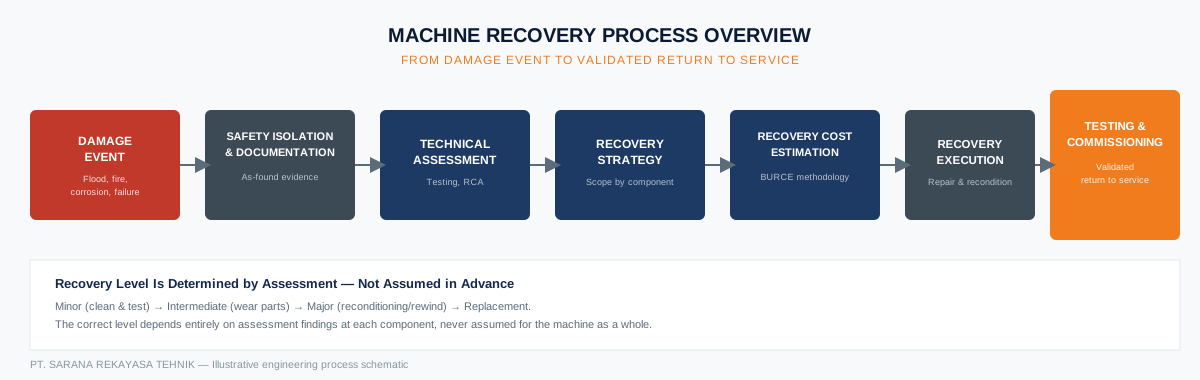
A structured machine recovery decision follows a defined sequence, rather than proceeding directly from visual inspection to a repair quotation:
This sequence is the core of SRT-ARM, the 7-stage methodology framework our engineering team follows on every project.
- Safety isolation and initial documentation. The asset is made safe, and as-found condition is documented before any cleaning or disassembly — this evidence matters both for engineering and, where applicable, insurance purposes.
- Technical assessment. Electrical testing, mechanical inspection, and — where the damage cause is unclear — root cause investigation determine the actual extent and nature of damage.
- Recovery strategy definition. Based on assessment findings, a recovery scope is defined component-by-component, not assumed for the machine as a whole.
- Recovery Cost Estimation. The recovery scope is translated into an itemized, engineering-based cost estimate — distinct from a simple repair quotation.
- Recovery execution. Cleaning, repair, component replacement, and reconditioning are carried out according to the defined scope.
- Testing and commissioning. The recovered asset is validated under staged, monitored conditions — ideally including production-representative testing, not only basic functional checks.
Levels of Machine Recovery
Recovery scope is typically categorized into levels of increasing extent, determined by assessment findings rather than assumed in advance:
| Level | Typical Scope |
|---|---|
| Minor Recovery | Cleaning, drying, and verification testing — no component replacement required |
| Intermediate Recovery | Replacement of wear components (seals, bearings, hardware) alongside thorough cleaning and testing |
| Major Recovery | Significant reconditioning, potentially including rewinding or major mechanical rework, while structural components remain sound |
| Replacement | Recommended when structural or core damage, repeated failure risk, or economic factors make recovery impractical relative to replacement |
This framework is explored in practical detail, using a real assessment scenario, in Flood-Damaged Electric Motor Recovery: Engineering Assessment and Recovery Strategy →.
Machine Recovery vs. Retrofit vs. Replacement
These three terms are frequently used loosely, but they describe distinct engineering decisions:
- Recovery restores a damaged asset back to its prior functional condition.
- Retrofit modernizes or upgrades a mechanically sound asset's control, automation, or performance capability — independent of whether damage occurred.
- Replacement is appropriate when recovery is not technically or economically justified, based on assessment findings.
In practice, these are not always mutually exclusive. A recovery project frequently reveals an opportunity for retrofit — for example, discovering during commissioning that a control system was operating on outdated, manually operated logic, and upgrading it as part of the same project. This scenario is illustrated in detail in Fire Damage Recovery of a 3-Stage Rotary Dryer Using the BURCE Methodology →, and the underlying decision criteria for retrofit specifically are covered in 5 Signs Your Industrial Machine Needs a Retrofit, Not a Replacement →.
How Recovery Cost Is Actually Estimated
A common misconception is that recovery cost can be reasonably estimated as a percentage of the machine's replacement value. In practice, this approach is unreliable — it has no direct relationship to the actual scope of work a specific damage event requires.
A defensible Recovery Cost Estimate is built upward from the component level: identified damage, at each component, translated into a specific recovery action (clean, repair, replace), then priced individually across labor, materials, testing, and commissioning. This is the foundation of SRT's Bottom-Up Engineering Recovery Cost Estimation (BURCE) methodology, detailed in Bottom-Up Engineering Recovery Cost Estimation: A Systematic Approach → and Beyond Cost Estimation: The SRT RCE Principle →.
Machine Recovery and Insurance Claims
Where machine damage is the subject of an insurance claim, the recovery process and the claims process are closely linked. The technical assessment underlying a recovery decision — particularly root cause findings — is often what determines whether a claim is defensible against policy exclusions such as normal wear or inadequate maintenance. This relationship between technical investigation and insurance outcome is covered in depth in Root Cause Analysis (RCA): A Practical Engineering Approach for Industrial Machinery and Insurance Claims →.
Industries That Rely on Machine Recovery
Machine recovery needs are not confined to a single sector. Common industries requiring these services include manufacturing and automotive, food and beverage processing, chemical and petrochemical, electronics, textile and garment, warehousing and logistics, and power and utilities — each with equipment types and operating conditions that shape the specific assessment approach required.
Why Recovery Decisions Should Not Be Made Before Assessment
The most consequential mistake in industrial machine recovery is reaching a decision — repair, retrofit, or replace — before a structured technical assessment has been completed. This mistake happens in both directions: assets are sometimes prematurely scrapped that a proper assessment would show to be recoverable, and assets are sometimes returned to service without adequate testing, risking premature failure or safety incidents.
A structured assessment protects against both outcomes by basing the recovery decision on verified evidence — test results, inspection findings, and engineering reasoning — rather than visual impression or assumption.
Key Takeaways
- Machine recovery restores damaged industrial assets to safe, functional condition — it is not automatically inferior to replacement, nor automatically preferable; the correct decision depends on assessment findings.
- Recovery scope should be determined component-by-component through technical assessment, not assumed for the machine as a whole.
- Commissioning should validate production-representative performance, not just basic functionality.
- Recovery cost should be built upward from actual scope of work, not estimated as a percentage of replacement value.
- Recovery projects frequently reveal retrofit opportunities worth evaluating on their own merit.
Have a damaged industrial asset and need to determine whether recovery, retrofit, or replacement is the right path? SRT's engineering team can conduct a structured technical assessment and Recovery Cost Estimation.
Start with our Machine Investigation Questionnaire → to get a PDF summary before your consultation.
Frequently Asked Questions
What is machine recovery?
Machine recovery is the structured engineering process of restoring damaged industrial machinery or equipment to safe, functional operating condition following an incident such as flood, fire, corrosion, or mechanical or electrical failure — as opposed to automatically replacing the asset.
Is machine recovery always cheaper than replacement?
Not always. Whether recovery is more economical than replacement depends on the extent of damage, the asset's remaining service life, lead time for a replacement unit, and the specific scope of work identified during technical assessment — which is why a structured Recovery Cost Estimation, not a general assumption, should inform the decision.
How long does a machine recovery process take?
Duration varies significantly based on the recovery level required — from a few days for minor cleaning and testing, to several weeks for major reconditioning or rewinding. The scope is only confirmed after technical assessment, not before it.
What is the difference between machine recovery and retrofit?
Machine recovery restores a damaged asset back to its prior functional condition. Retrofit modernizes or upgrades a mechanically sound asset's control, automation, or performance capability — the two are often combined when a recovery project also presents an opportunity for improvement.
Who typically needs machine recovery services?
Industrial manufacturers, insurance companies, loss adjusters, and asset owners across manufacturing, food and beverage, chemical, electronics, textile, logistics, and power sectors typically require machine recovery services following unplanned damage events.
Explore the Machine Recovery Series
How to tell whether retrofit is the right path instead of recovery or replacement.
A clear definition of how these three interventions differ.
What to do — and avoid — immediately after a machine damage event.
When a legacy control system — not the machine itself — is what actually needs replacing.
When a production requirement justifies a custom-built machine.
Reconstructing specifications when the manufacturer and drawings are gone.
Measurement-based assessment for gradual, progressive damage.
Why visible fire damage isn't the only concern for panel safety.
The unified framework that ties this entire series together.
The 5-stage framework SRT uses to build recovery cost from the component level up.
A detailed walkthrough of recovery levels applied to a real assessment scenario.
Why a defensible Recovery Cost Estimate must be engineering- and commercially-defensible.
How RCA findings shape both recovery scope and insurance claim outcomes.
Machine recovery methodology applied in practice, from assessment to commissioning.