
Not every technical report handed to you is equally reliable — here is what actually separates a defensible engineering assessment from one that only looks like one.
Executive Summary. Loss adjusters evaluating industrial machinery claims routinely receive technical reports of varying quality — from rigorous, evidence-based assessments to conclusions with little supporting documentation. This guide sets out what to look for in a machinery damage report, common red flags that indicate a weak assessment, the questions worth asking a technical assessor, and how to evaluate whether a proposed recovery cost estimate is actually defensible. The goal is not to make the loss adjuster an engineer, but to equip them to recognize the difference between a report that will hold up under scrutiny and one that will not.
Why Report Quality Varies So Much
Machinery damage assessments supporting insurance claims are commissioned by a range of parties — sometimes the insurer, sometimes the policyholder, sometimes a repair contractor with a direct interest in the scope being approved. This variation in who commissions the report, and why, is the single biggest driver of variation in report quality and reliability.
A report from a party with a financial stake in a particular outcome is not automatically wrong — but it warrants closer scrutiny than one from an independent assessor with no interest in whether the claim is approved, reduced, or the scope expanded.
What Strengthens a Machinery Damage Report
| Element | Why It Matters |
|---|---|
| Root cause identified, not just failure mechanism | Distinguishes a covered sudden event from a potentially excluded gradual condition (see Root Cause Analysis below) |
| Conclusions traceable to specific evidence | Test results, measurements, and photographs — not inference presented as fact |
| As-found condition documented before cleaning/repair | Preserves the evidentiary record before it is lost during recovery work |
| Alternative causes explicitly considered and ruled out | Demonstrates the investigation was not confirmation-seeking |
| Fact, judgment, and assumption clearly distinguished | A report that blurs these together is harder to defend under scrutiny |
| Recovery cost itemized by component and category | Traceable to actual scope of damage, not estimated as a percentage of asset value |
Red Flags in a Technical Report
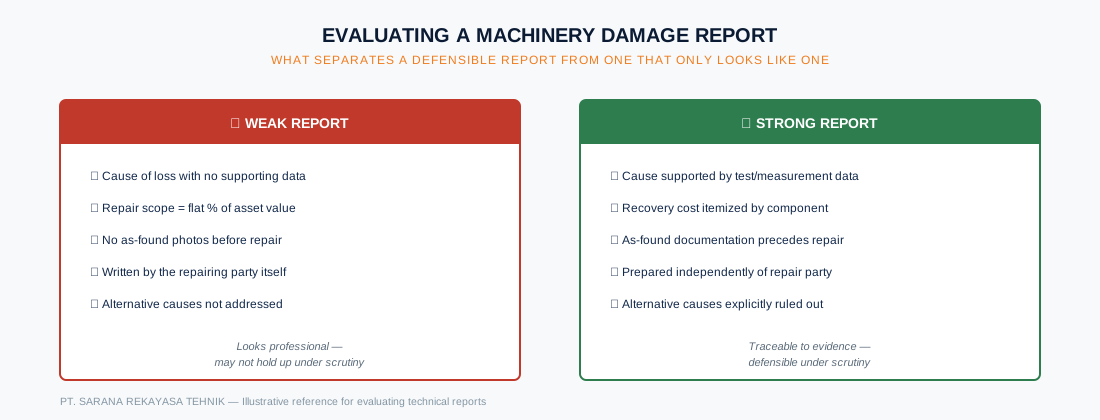
WEAK REPORT
- States cause of loss with no supporting test or measurement data
- Repair scope estimated as a flat percentage of replacement value
- No as-found photographs prior to cleaning or repair
- Written by the same party proposing to perform the repair
- Does not address why alternative causes were ruled out
STRONG REPORT
- Cause of loss supported by specific test results or physical evidence
- Recovery cost itemized: labor, materials, testing, commissioning
- As-found documentation precedes any cleaning or disassembly
- Prepared independently of the party performing the repair
- Explicitly states investigation limitations, where relevant
Understanding the Root Cause vs. Symptom Distinction
One of the most common weaknesses in machinery claim reports is stopping the investigation at the failure mechanism rather than tracing it to the actual root cause. "The bearing seized" is a mechanism, not a cause — it does not, on its own, indicate whether the underlying condition was a sudden covered event or a gradual condition potentially subject to exclusion. This distinction, and how to evaluate whether an investigation has actually reached root cause, is covered in detail in Root Cause Analysis: A Practical Engineering Approach →.
Evaluating a Proposed Recovery Cost Estimate
A recovery cost estimate deserves the same scrutiny as the damage assessment itself. Questions worth asking:
- Is the cost itemized, or presented as a lump sum? An itemized estimate — labor, parts, testing, commissioning, by component — can be checked against the documented damage. A lump sum figure cannot.
- Does the scope match the documented damage? A recovery scope that is broader than what the damage assessment actually documented warrants explanation.
- Is the estimate based on a percentage of asset value? This approach has no direct relationship to actual scope of work and should be treated with caution regardless of who prepared it.
- Who prepared the estimate, and is that party also performing the work? Not disqualifying on its own, but relevant context for how much independent scrutiny the estimate warrants.
The engineering basis for how a defensible Recovery Cost Estimate should be structured is covered in Beyond Cost Estimation: The SRT RCE Principle →.
Questions Worth Asking a Technical Assessor
- What specific evidence supports the stated cause of loss?
- What alternative causes were considered, and why were they ruled out?
- What is the basis for the repairability determination — was it purely visual, or supported by testing?
- How was the recovery cost estimate built up, and can it be itemized by component?
- What is the assessor's relationship to the party proposing to perform the repair, if any?
- What, if anything, remains uncertain or would require further testing to confirm?
A credible independent assessor should be able to answer each of these directly, with specifics — vague or evasive answers to any of them are themselves worth noting.
When to Request an Independent Assessment
Requesting an independent technical assessment is generally warranted when: the existing report comes from a party with a clear financial interest in the outcome, the stated cause of loss lacks supporting evidence, the claim value is significant relative to the cost of an independent assessment, or the case involves a complex failure mechanism with more than one plausible cause.
An independent assessment is not an accusation that the existing report is wrong — it is a standard risk-management step for claims where the stakes justify the additional scrutiny.
Key Takeaways
- Report quality varies significantly based on who commissioned it and their interest in the outcome — this context should inform how much scrutiny a report receives.
- A strong report identifies root cause (not just failure mechanism) and traces every key conclusion to specific evidence.
- Recovery cost estimates should be itemized and traceable to documented damage — treat percentage-of-value estimates with caution.
- A credible independent assessor should be able to clearly answer direct questions about their evidence, methodology, and any limitations.
Evaluating a machinery claim and need an independent technical assessment or a second opinion on an existing report? SRT's engineering team provides evidence-based damage assessment, root cause analysis, and Recovery Cost Estimation.
Frequently Asked Questions
What should a loss adjuster look for in a machinery damage report?
A strong report identifies root cause (not just failure mechanism), links every conclusion to specific physical evidence or test results, documents as-found condition with photographs, and clearly separates confirmed fact from engineering judgment and assumption.
What is a red flag in a machinery damage assessment report?
Common red flags include a conclusion with no supporting evidence, a repair scope estimated as a percentage of asset value rather than itemized, a report from a party with a direct financial interest in the outcome, and cause of loss stated without ruling out alternative explanations.
Why request an independent technical assessment for a machinery claim?
An independent assessment, conducted without a financial interest in the claim outcome, provides more credible and defensible findings than an assessment from the repair contractor or an interested party.
How can a loss adjuster evaluate whether a recovery cost estimate is reasonable?
A reasonable Recovery Cost Estimate is itemized by component and cost category — labor, materials, testing, commissioning — traceable to the specific damage identified during assessment, rather than presented as a single lump sum or percentage of replacement value.
What questions should a loss adjuster ask a technical assessor?
Useful questions include: what specific evidence supports the stated cause of loss, what alternative causes were considered and ruled out, what is the basis for the repairability determination, and how was the recovery cost estimate built up.
Related Reading
Why weak investigation reports get insurance claims rejected.
How to distinguish root cause from symptom and failure mechanism.
What a defensible, itemized Recovery Cost Estimate should include.
What to gather, and when, to support the report you're reviewing.
Part of the complete guide: Insurance Engineering Explained →