
A mechanically sound machine frequently outlives the control system running it — the engineering question is not whether to replace the machine, but whether to replace only what has actually become obsolete.
Executive Summary. Legacy production equipment frequently retains a mechanically sound structure long after its PLC, servo, and safety systems become obsolete, unsupported, or operationally limiting. An automation retrofit modernizes these control systems — PLC, servo drives, HMI, and safety circuits — while retaining the proven mechanical platform, extending useful service life without the cost and lead time of full replacement. This article covers the engineering signs that indicate a control system has reached this point, what should typically be retained versus replaced, the retrofit process, and the factors that determine whether retrofit is the right decision relative to full replacement.
What an Automation Retrofit Actually Involves
An automation retrofit is the engineering process of modernizing a machine's control, automation, and safety systems — typically its PLC, servo or motion control system, HMI, and electrical panel — while retaining mechanically sound structural and motion components such as the frame, traverse mechanisms, and drivetrain.
This distinguishes automation retrofit from a general overhaul: the scope is deliberately concentrated on the systems that govern how the machine is controlled and monitored, based on the engineering premise that control technology becomes obsolete on a materially shorter cycle than well-built mechanical structure.
Why Legacy Control Systems Become a Liability
A machine's mechanical platform — frame, bearings, drivetrain, structural base — can often remain sound for decades with proper maintenance. Its control system typically cannot keep pace on the same timeline, for several concrete reasons:
- Component obsolescence. PLC models, servo drives, and HMI hardware are discontinued by manufacturers over time, making replacement parts increasingly difficult and expensive to source following a fault.
- Loss of programming and support expertise. Older platforms and proprietary programming languages become harder to find qualified technicians for, extending downtime when faults occur.
- Absent or limited diagnostics. Legacy systems frequently provide minimal fault data, turning troubleshooting into a slow, trial-and-error process rather than a data-driven one.
- Safety standard gaps. Control and safety circuit designs considered acceptable decades ago may no longer meet current safety practice, particularly around machine guarding interlocks and emergency stop circuits.
- Integration limitations. Legacy systems are frequently unable to communicate with newer plant-level monitoring, data collection, or production management systems.
Engineering Signs a Retrofit Should Be Considered
| Sign | Why It Matters |
|---|---|
| PLC/servo model no longer manufactured | Replacement components become scarce and expensive; a single failure can cause extended, unplanned downtime |
| Frequent faults with no diagnostic data | Legacy systems often cannot pinpoint fault location or cause, extending troubleshooting time significantly |
| Reliance on relay logic or manual operation | Indicates the control system predates practical PLC adoption for that function — inherently less reliable and harder to maintain |
| Operators struggle with the interface | An outdated or unclear HMI increases operator error risk and training time for new staff |
| Cannot integrate with newer plant systems | Limits visibility into machine performance and blocks broader digitalization or monitoring initiatives |
| Safety circuit does not meet current practice | A direct safety and compliance concern independent of production considerations |
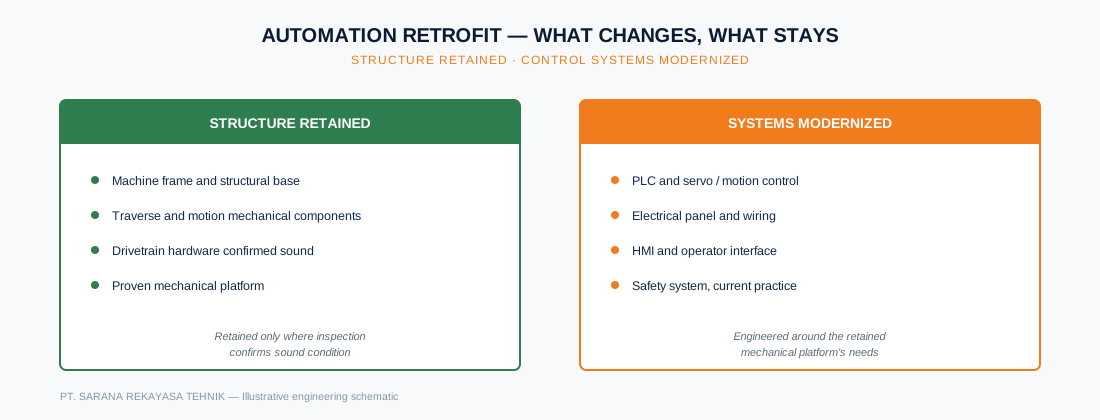
What Is Typically Retained vs. Modernized
STRUCTURE RETAINED
- Frame and structural base
- Traverse and motion mechanical components
- Proven mechanical platform, confirmed sound through inspection
SYSTEMS MODERNIZED
- PLC and servo/motion control
- Electrical panel and wiring
- HMI and operator interface
- Safety system, updated to current practice
What is retained and what is replaced should be determined by engineering assessment on a component-by-component basis — never assumed uniformly across the machine. A mechanical component should only be retained where inspection confirms it remains within acceptable tolerance and condition for continued service.
The Automation Retrofit Process
- Mechanical and control system assessment. Confirms which mechanical components are sound enough to retain, and defines the full scope of control, automation, and safety system replacement required.
- Control system engineering design. New PLC program, servo/motion control configuration, panel layout, and HMI design are developed to match the retained mechanical platform's actual operating requirements — not a generic template.
- Panel and wiring rework. Electrical panels are rebuilt or replaced, wiring reworked to current standards, and new control hardware installed.
- Servo and motion system installation. Where motion control is being upgraded, new servo drives and motors are installed and mechanically integrated with retained drivetrain components.
- Software commissioning. New PLC logic and HMI screens are loaded, configured, and tuned to the specific machine.
- Functional and safety testing. The retrofitted control system is tested against the machine's actual production requirements, including verification of all safety interlocks and emergency stop circuits.
- Staged commissioning and handover. The machine is brought back into service under monitored conditions before full production handover.
Automation Retrofit vs. Full Replacement
The decision between retrofitting the control system and replacing the machine entirely should weigh several factors together, not any single one in isolation:
- Mechanical condition. A retrofit is only justified when the underlying mechanical platform is confirmed sound — retrofitting the controls of a mechanically failing machine simply defers a larger problem.
- Cost and lead time. Retrofit is frequently faster and less capital-intensive than sourcing and installing an entirely new machine, particularly for large or specialized equipment with long replacement lead times.
- Production continuity. Operators already familiar with the mechanical operation of the machine require less retraining than with an entirely new machine, once the control interface is modernized.
- Expected remaining service life. A retrofit engineered around a sound mechanical platform can reasonably extend service life by a decade or more — this should be a considered engineering estimate, not an assumption.
This retrofit-versus-replacement question sits within the broader recovery decision framework covered in What is Machine Recovery? A Complete Guide for Industrial Asset Owners →, and the specific signs that indicate retrofit over replacement are explored further in 5 Signs Your Industrial Machine Needs a Retrofit, Not a Replacement →.
Risks and Considerations
- Downtime during changeover. Retrofit work requires the machine to be offline; production scheduling and, where applicable, temporary alternative capacity should be planned in advance.
- Incomplete original documentation. Older machines frequently lack complete original electrical drawings, requiring the retrofit engineering team to document the existing system before design work begins — this is a standard part of a properly scoped retrofit project, not an unplanned complication.
- Mechanical components assumed sound without inspection. Proceeding with a control system retrofit without properly assessing mechanical condition risks discovering — mid-project or after commissioning — that mechanical work was also required.
Key Takeaways
- Control systems typically become obsolete on a shorter cycle than well-maintained mechanical structure — this gap is the engineering basis for automation retrofit.
- Retrofit scope should be determined by assessment of both mechanical condition and control system limitations, not assumed uniformly.
- What is retained versus replaced should be confirmed component-by-component through inspection.
- Retrofit is frequently more economical and faster than full replacement, but this should be confirmed by engineering assessment for the specific machine in question.
Running equipment with a legacy or unsupported control system? SRT's engineering team can assess mechanical condition and scope an automation retrofit engineered around your machine's actual operating requirements.
Frequently Asked Questions
What is an automation retrofit?
An automation retrofit is the process of modernizing a machine's control, automation, and safety systems — such as its PLC, servo drives, and HMI — while retaining its mechanically sound structural and motion components, rather than replacing the entire machine.
How do I know if my machine needs an automation retrofit?
Common signs include a PLC model or brand that is no longer supported or manufactured, frequent unexplained faults with no diagnostic data, reliance on relay logic or manual operation, an HMI that operators struggle to use, and an inability to integrate with newer plant systems or safety standards.
Is automation retrofit cheaper than buying a new machine?
It depends on the mechanical condition of the existing machine and the retrofit scope required. When the mechanical structure is sound, retrofit is often significantly more economical than full replacement, but this should be confirmed through engineering assessment rather than assumed.
How long does a PLC and servo retrofit typically take?
Duration depends on the complexity of the control system and the extent of mechanical work required, ranging from a few weeks for a straightforward PLC and HMI upgrade to significantly longer for projects involving full servo motion system redesign.
What happens to the mechanical parts during an automation retrofit?
Mechanically sound components — frame, structural base, and motion hardware confirmed through assessment to be in good condition — are typically retained. Only the control, automation, and safety systems are replaced or modernized.
Part of the complete guide: What is Machine Recovery? A Complete Guide →
Also part of: What is Industrial Automation Engineering? →
Also read: Special Purpose Machine vs Off-the-Shelf Equipment →
Practical example: Case Study — Fire-Damaged Servo-Driven Drilling Equipment →