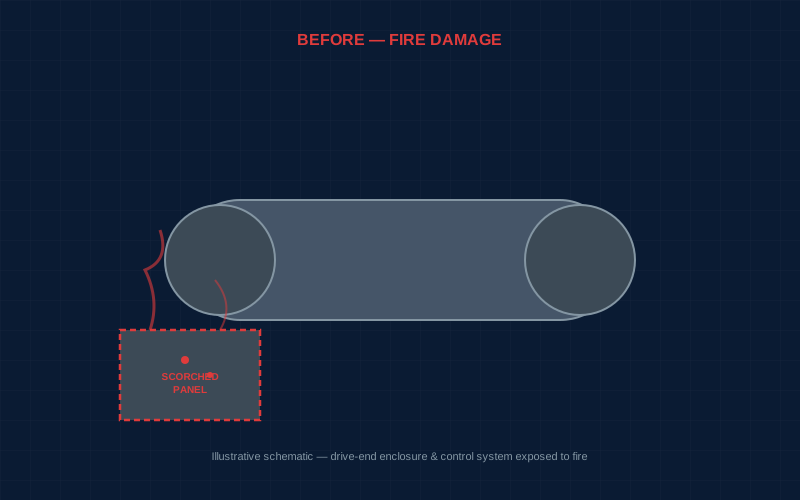
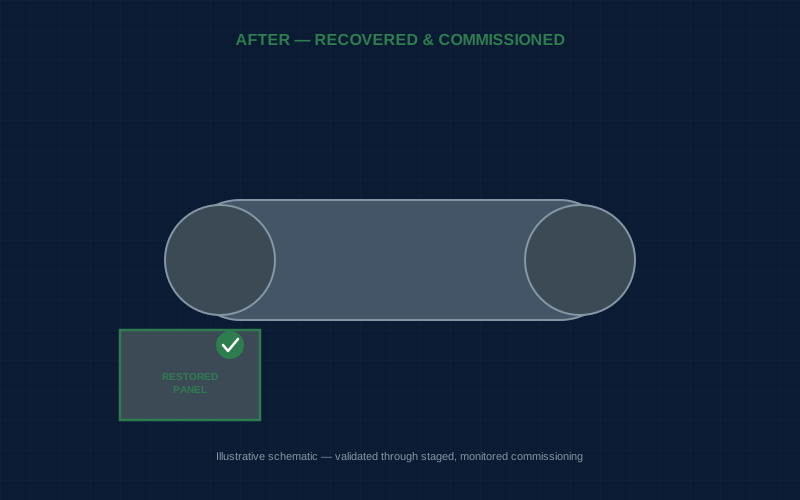
Drag to compare before and after recovery condition (illustrative)
INSURANCE ENGINEERING · MACHINERY RECOVERYA structured, evidence-based recovery of a fire-damaged industrial 3-stage rotary dryer — demonstrating how component-level engineering assessment restores asset reliability while identifying opportunities for process improvement.
Project Overview
The subject of this case study is an industrial 3-stage rotary dryer operating within a bulk material processing facility in Indonesia. The equipment is a critical asset in the production line, responsible for reducing moisture content in processed bulk material to meet quality and shelf-life requirements prior to packaging.
Following an electrical fault in an adjacent junction box, the dryer's drive-end enclosure and a section of the heating and control system were exposed to direct flame and sustained heat for a limited but significant duration before the fire was suppressed. The incident resulted in localized thermal damage, smoke contamination across multiple subsystems, and suspected degradation of electrical insulation and control components.
The objective of the engineering assignment was twofold: first, to determine — through structured technical evaluation rather than visual assumption — which components were genuinely non-functional and which remained serviceable; and second, to develop and execute a recovery program that would restore the dryer to full operational reliability within the shortest practicable timeframe, without compromising long-term equipment integrity or process safety.
PT Sarana Rekayasa Tehnik (SRT) was engaged to conduct the technical investigation, define the recovery scope, and execute the restoration works under its Bottom-Up Engineering Recovery Cost Estimation (BURCE) methodology.
The Challenge
Fire-related damage to rotating and thermally regulated industrial equipment presents a distinct set of technical challenges that differ substantially from mechanical breakdown or corrosion-related failure. In this case, four categories of damage required independent evaluation:
Heat Exposure. Direct flame contact and radiant heat affected structural steel members, bearing housings, and drive components in the immediate vicinity of the ignition source. Elevated temperatures can alter the metallurgical properties of load-bearing components, reduce lubricant effectiveness, and induce dimensional distortion in precision-fitted assemblies — none of which are reliably identifiable through visual inspection alone.
Smoke and Particulate Contamination. Combustion byproducts, including soot and partially oxidized residue, infiltrated control panels, terminal blocks, and sensor housings beyond the immediate fire zone. Smoke contamination is a well-documented cause of latent electrical failure, as conductive residue can create unintended current paths across insulation surfaces that may not manifest as a fault until the equipment is re-energized.
Damage to Electrical Systems. The control panel, wiring harnesses, and instrumentation associated with temperature regulation and drive control were exposed to a combination of heat and smoke. Insulation resistance, continuity, and functional response of control elements required individual verification, as compromised electrical components pose both an operational reliability risk and a potential safety hazard if returned to service without proper testing.
Mechanical Degradation. Bearings, seals, and drive-train components subjected to elevated temperature are susceptible to accelerated wear, lubricant breakdown, and micro-fracturing that is not always externally visible. Continued operation of a compromised mechanical assembly can result in secondary, more severe failure.
Production Downtime. As the dryer represented a bottleneck process in the facility's production sequence, extended downtime carried direct operational consequences. However, production pressure alone did not justify bypassing a structured assessment — a hastily executed repair based on incomplete evaluation would risk premature re-failure, extending total downtime rather than reducing it.
For these reasons, an immediate wholesale replacement approach was neither technically justified nor economically prudent. A structural assessment was required to establish, on an evidence basis, which components had genuinely lost function and which retained engineering integrity — the foundation of the recovery-before-replacement philosophy applied throughout the project.
Engineering Assessment
SRT's investigation followed the Bottom-Up Engineering Recovery Cost Estimation (BURCE) methodology, an approach in which recovery decisions are built upward from verified component-level condition data rather than derived from a top-down assumption applied to the machine as a whole.
Machine Breakdown Structure (MBS). The dryer was first decomposed into its constituent systems and subsystems: the mechanical drive system, the heating and steam distribution system, the electrical and control system, the structural frame, and the instrumentation and safety system. This breakdown ensured that every functional area of the machine — not only the zones with visible fire damage — was formally included in the assessment scope.
Damage Assessment. Each component within the breakdown structure was individually inspected and classified according to damage type (thermal, smoke contamination, or mechanical), severity, and functional impact. Where damage extent could not be conclusively determined through visual and physical inspection alone, targeted testing was applied — including insulation resistance testing on electrical components, dimensional checks on drive-train elements, and functional verification of control instrumentation.
Recovery Strategy. For each component classified as damaged, the appropriate recovery action was determined individually rather than applying a uniform response across the machine. Recovery actions ranged from cleaning and reconditioning, for components affected primarily by surface contamination, through repair and recalibration, for components with partial functional degradation, to full replacement, reserved for components where testing confirmed damage beyond serviceable limits.
Component Evaluation. Particular attention was given to components in the boundary zone between confirmed-damaged and confirmed-serviceable areas, where fire and smoke exposure was partial. These borderline components were subjected to the most rigorous testing, as an incorrect classification in either direction carries consequences — unnecessary replacement increases cost and lead time without engineering justification, while premature return to service of a compromised component introduces operational risk.
Engineering Decision Process. Every recovery decision — whether to clean, repair, or replace — was documented with its supporting technical evidence: inspection findings, test results, and the engineering rationale connecting the two. This traceability is a defining characteristic of the BURCE approach and ensures that the recovery program can be reviewed and defended on technical grounds by any stakeholder, including insurers, loss adjusters, or the asset owner's own technical team.
Recovery Execution
Following completion of the engineering assessment and definition of the recovery scope, execution proceeded in a structured sequence aligned with the findings of each subsystem evaluation.
- Cleaning — Smoke residue and combustion byproducts were removed from control panels, terminal enclosures, and mechanical housings using methods appropriate to each substrate.
- Inspection — A secondary inspection pass verified that no damage had been obscured by surface contamination.
- Mechanical Repair — Drive-train and structural elements were disassembled, reworked, or restored to design tolerance, including alignment-critical components affected by thermal exposure.
- Electrical Restoration — Wiring, terminal connections, and control panel components were repaired or replaced based on individual test results, with insulation resistance and continuity re-verified prior to re-energization.
- Component Replacement — Heat-affected seals, select instrumentation, and specific electrical elements confirmed beyond serviceable limits were replaced on a like-for-like or engineering-equivalent basis.
- Alignment — Drive components were realigned to design specification following mechanical repair and reassembly.
- Functional Testing — Each restored subsystem was tested independently — drive rotation and load response, heating element response, and control system signal verification — prior to integrated system testing.
- Commissioning — The dryer was brought back into operation under supervised conditions, with performance monitored against baseline operational parameters.
Engineering Improvement
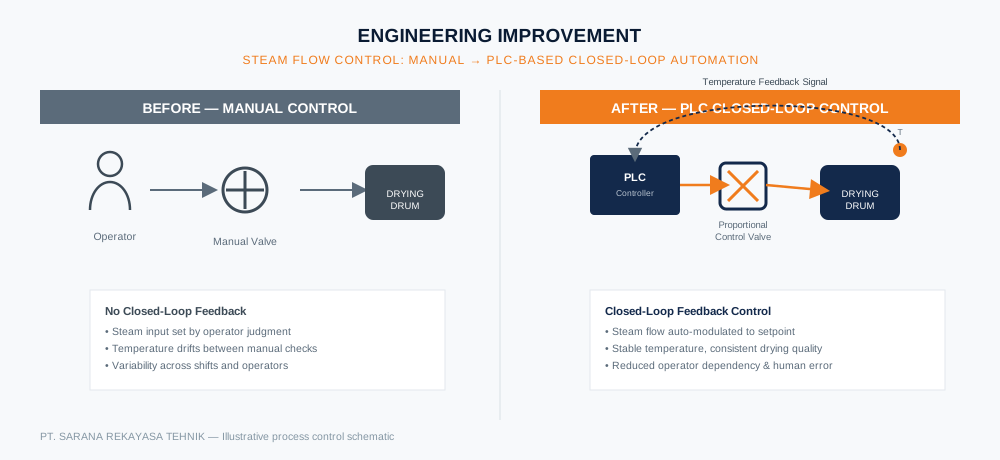
Figure 2 — Process control comparison: manual steam regulation versus PLC-based closed-loop automation implemented following commissioning observations.
During the commissioning phase, a process observation was made that fell outside the direct scope of fire damage recovery but carried direct relevance to the dryer's long-term operational reliability: the steam flow supplying the heating system was found to be manually controlled by the operator, with no automated linkage between steam input and drying chamber temperature.
Under a strict repair-to-original-condition scope, this finding would not have required action, as manual steam control was the pre-incident configuration rather than damage caused by the fire. However, consistent with SRT's engineering philosophy — that a recovery project is also an opportunity to identify and address process limitations discovered during hands-on assessment — this finding was raised as a formal engineering improvement recommendation.
SRT proposed the following process control upgrade:
- Installation of a proportional control valve on the steam supply line, replacing the manually operated valve previously in use.
- Integration of steam flow control with drying chamber temperature, establishing a closed-loop relationship between process temperature and heating input rather than relying on operator judgment.
- Implementation of PLC-based automatic control, allowing the temperature setpoint to be defined and maintained programmatically, with the control logic automatically modulating steam flow to hold the process within specification.
The engineering rationale for this recommendation rested on several observed benefits:
- Stable drying temperature — automated closed-loop control maintains chamber temperature within a narrower band than manual adjustment.
- Reduced operator dependency — automated control standardizes process regulation independent of operator experience level.
- Improved product consistency — tighter process control translates directly into more consistent moisture reduction across production batches.
- Higher productivity — reduced need for manual monitoring allows operators to be allocated to other value-adding tasks.
- Reduced human error — removing manual valve adjustment eliminates a recognized source of process variability.
It is important to note that this improvement was not part of the original fire damage recovery scope, but was identified and proposed as a direct result of the hands-on process visibility gained during commissioning — illustrating a broader principle that thorough commissioning activity often surfaces process improvement opportunities that would not be visible through documentation review alone.
Results
Following completion of the recovery program and implementation of the proposed control system improvement, the dryer was returned to full production service. The outcomes of the project can be summarized as follows:
- The machine was successfully returned to operation within the recovery timeframe defined at project initiation, with all subsystems verified through independent and integrated functional testing prior to handover.
- The drying process now operates under reliable, closed-loop process control, replacing the previous manual steam regulation with an automated temperature-linked system.
- Production stability improved, as temperature excursions associated with manual control adjustment were eliminated from the process.
- Drying quality was enhanced, with tighter control over the moisture-reduction process supporting more consistent product output.
- Operational risk was reduced, both through the resolution of confirmed fire-related damage and through the removal of a manual control step that had previously introduced process variability.
Equally significant, the recovery program was executed on the basis of verified, component-level technical evidence rather than blanket assumption — meaning that the scope of work performed, and the associated resource allocation, was proportionate to the actual condition of the asset.
Key Engineering Lessons
- Structured engineering assessment is not optional following thermal incidents. Visual inspection alone is insufficient to determine the functional status of fire- and smoke-exposed components; targeted testing is required to distinguish genuine damage from superficial contamination.
- Recovery-before-replacement is both technically sound and economically responsible — when supported by evidence. A structured component-level assessment frequently reveals that a substantial proportion of the asset remains serviceable.
- Evidence-based decision making protects all stakeholders. Documenting the technical basis for every recovery decision creates a defensible record for insurers, asset owners, and independent reviewers alike.
- Boundary-zone components require the most rigorous evaluation. Partially exposed components carry the highest risk of misclassification in either direction.
- Commissioning is a distinct and essential project phase, not a formality. Functional testing under supervised, incrementally staged conditions is what ultimately validates whether a recovery program has been successful.
- Recovery projects frequently reveal opportunities for process improvement beyond the immediate damage scope. This visibility should be treated as a value-adding input rather than incidental observation.
- Continuous process improvement should be considered a natural extension of recovery engineering, particularly where a low-complexity intervention offers a meaningful and durable improvement to process reliability.
- Engineering optimization following recovery should be evaluated on its own technical merit, independent of whether it falls within the originally defined damage scope, provided it is clearly identified, justified, and communicated as a distinct recommendation.
BURCE Methodology Highlight
This project illustrates the practical application of PT Sarana Rekayasa Tehnik's Bottom-Up Engineering Recovery Cost Estimation (BURCE) methodology in a real operational context. Rather than beginning from an assumed damage extent or a fixed percentage-based estimate, the recovery program was constructed upward from individually verified component-level findings — through machine breakdown structuring, targeted damage assessment, component-specific recovery strategy, and a fully traceable engineering decision process.
The successful commissioning of the dryer, together with the identification and implementation of a meaningful process control improvement during that same phase, demonstrates the value of an engineering methodology in which every recovery decision is developed from evidence and validated through structured, staged testing — rather than assumption. This is the operating principle that underpins SRT's approach to industrial asset recovery across insurance, forensic, and technical assessment engagements.
Facing a similar fire, flood, or mechanical damage scenario on critical process equipment? Contact the SRT engineering team for an independent technical assessment.
Part of the complete guide: What is Machine Recovery? A Complete Guide →
Also read: Fire Damage to Electrical Panels: Recovery or Replace? →