
A technically sound machinery claim can still stall — or be reduced — simply because the supporting documentation has gaps. Here is what actually needs to be gathered, and when.
Executive Summary. Industrial machinery insurance claims are evaluated on the strength of their documentation as much as the underlying technical findings. This guide sets out what documentation matters at each stage — before a loss occurs, in the first 24 hours after damage, and throughout the technical assessment — along with the most common gaps that weaken an otherwise defensible claim. The goal is a document package where every conclusion can be traced back to specific, retained evidence.
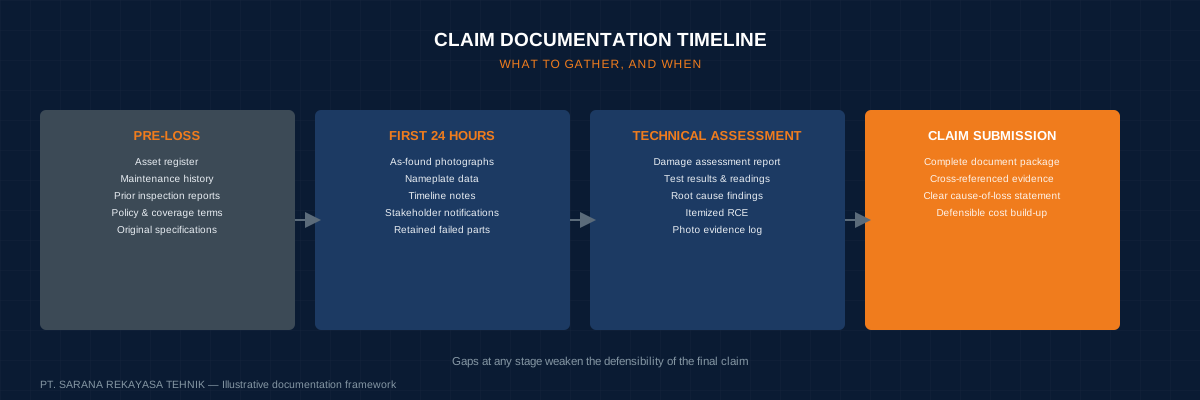
Why Documentation Determines Claim Outcomes
A machinery insurance claim is, at its core, an argument supported by evidence: what happened, why it happened, what it will cost to put right, and why that cost is reasonable. Each of these elements needs to be traceable to something concrete — a photograph, a test reading, a maintenance record, an itemized cost build-up — rather than asserted on its own.
This is where technically valid claims sometimes underperform. The underlying engineering conclusion may be entirely sound, but if the documentation trail supporting it is incomplete, inconsistent, or assembled too late to capture the relevant evidence, the claim becomes harder to defend — and easier to challenge or reduce during review.
Documentation From Before the Loss
Some of the most valuable claim documentation is generated long before any damage occurs — and cannot be reconstructed afterward if it was never kept.
- Asset register entry — make, model, serial number, installation date, and original specification for the affected equipment.
- Maintenance history — service records, prior repairs, and any recurring issues, which help establish the equipment's condition immediately before the loss event.
- Prior inspection or condition reports — any earlier technical assessment, even informal, that documents baseline condition.
- Policy and coverage documentation — the specific terms, exclusions, and valuation basis applicable to the equipment.
- Original purchase or replacement value records — supporting both coverage confirmation and any repair-vs-replace cost comparison later in the claim.
Documentation From the First 24 Hours
The period immediately following a damage event is when evidence is most complete and least degraded. SRT's Damage Assessment Checklist: First 24 Hours → covers this in detail; the core documentation to prioritize includes:
- Wide-angle and close-up as-found photographs, taken before any cleaning or repair begins
- Nameplate and identification data confirming the specific unit affected
- Contemporaneous notes on when and how the damage was discovered
- A record of any emergency actions taken, and why, particularly where they may have altered as-found condition
- Retained physical components, where removed — these often become part of the technical evidence base
Documentation From the Technical Assessment
Once a structured technical assessment begins, it should generate its own documentation trail — this is typically the core evidentiary package a claim is built around:
| Document | What It Establishes |
|---|---|
| Damage assessment report | Component-by-component findings, classified by damage type and severity |
| Test results and readings | Insulation resistance, dimensional checks, functional verification — objective data behind conclusions |
| Root cause findings | What caused the loss, supported by physical evidence rather than assumption |
| Itemized Recovery Cost Estimate | Cost built up component-by-component, traceable to specific findings — see Beyond Cost Estimation → |
| Photo evidence log | Cross-referenced to specific findings and report sections, not a loose collection of images |
This is the documentation category where an independent technical assessor typically adds the most value — not just performing the assessment, but ensuring its outputs are structured in a way that holds together as a claim document, not just an internal engineering record.
Documentation Specific to Damage Cause
Certain damage causes warrant additional documentation beyond the general checklist above:
- Flood/water damage: the approximate water level reached, and how long the equipment was exposed — details that are difficult to reconstruct once water recedes. See Flood-Damaged Electric Motor Recovery →.
- Fire damage: documentation of smoke and heat exposure zones separately from direct flame contact zones, since these often require different testing and carry different recovery implications. See Fire Damage to Electrical Panels →.
- Corrosion: since corrosion develops over time rather than as a single event, documentation establishing onset and progression — where available — is particularly valuable. See Corrosion Damage Assessment →.
Common Documentation Gaps That Weaken Claims
- Cleanup before documentation. Well-intentioned cleanup, done before photographs are taken, removes evidence that cannot be recreated afterward.
- Cost presented without itemization. A recovery cost estimate presented as a single lump sum or flat percentage is inherently harder to defend than one traceable to specific components and findings.
- Missing chain of custody for removed components. If a failed part is discarded before assessment, the physical evidence it might have provided is permanently lost.
- Assessment commissioned too late. Involving a technical assessor only after informal repair has begun means key as-found evidence may already be gone.
Key Takeaways
- Claim strength depends on consistency across documentation, not any single report.
- Pre-loss records — maintenance history, prior inspections — cannot be reconstructed after a loss; their absence shifts more weight onto post-loss evidence.
- The first 24 hours after damage is when the most valuable evidence is available and most at risk of being lost.
- An itemized, component-level Recovery Cost Estimate is inherently more defensible than a lump-sum figure.
- Involving an independent technical assessor early improves both the quality and the defensibility of the resulting documentation.
Frequently Asked Questions
What is the single most important document for a machinery insurance claim?
There isn't one single document that carries a claim — it's the consistency across documents that matters most. A damage assessment report is only as strong as the as-found photographs, test data, and maintenance history that support its conclusions.
What if pre-loss maintenance records don't exist or are incomplete?
Incomplete pre-loss records don't automatically invalidate a claim, but they narrow what can be conclusively demonstrated. In their absence, the technical assessment relies more heavily on physical evidence gathered post-loss, which makes early, careful documentation even more important.
Who is responsible for compiling claim documentation — the policyholder or the insurer?
Both parties typically contribute: the policyholder generally supplies pre-loss records and as-found documentation, while the technical assessment report is usually commissioned to support the claim review process, whether by the policyholder, insurer, or loss adjuster.
How long should claim documentation be retained after a machine is recovered?
Documentation is generally worth retaining well beyond claim settlement, both for internal asset records and in case questions arise later regarding the equipment's condition or repair history.
Related Reading
What to document immediately after machine damage occurs.
What strengthens a technical report from the reviewer's perspective.
How root cause findings are documented and defended.
Part of the complete guide: Insurance Engineering Explained →