
From recreating a component with no surviving drawings to designing the control logic behind a fully automated line — engineering services cover the design and reconstruction work that repair alone cannot.
Executive Summary. Industrial engineering services encompass reverse engineering, mechanical and electrical design, PLC programming, and automation — work that designs, redesigns, or reconstructs systems rather than simply restoring them. This guide explains what each discipline covers, how they differ from machinery repair, when a facility typically needs them, and how SRT approaches engineering projects using the same evidence-based discipline applied across all our work.
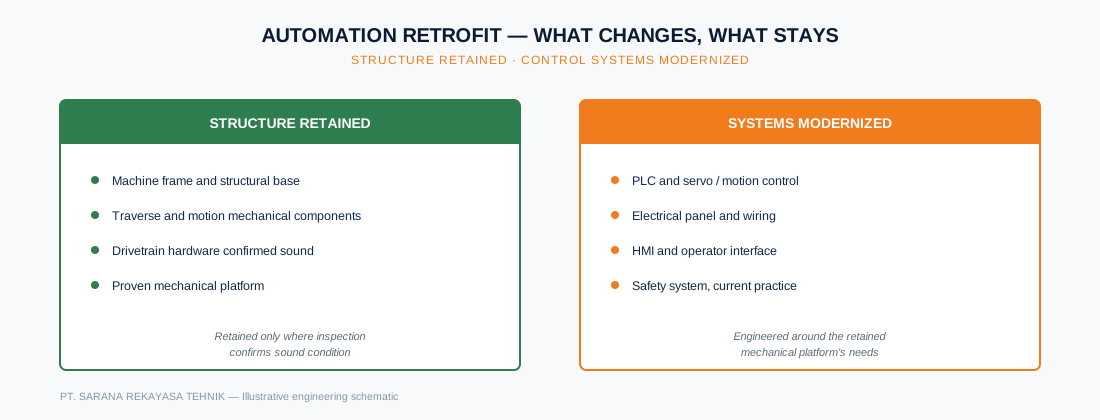
What Industrial Automation Engineering Actually Means
Engineering services sit apart from repair and recovery work in a specific way: rather than restoring an existing machine to its prior working condition, engineering work designs something — a missing part, an upgraded control system, a new automated process — that may not have existed in its current form before.
This distinction matters practically. A repair project starts from a known baseline (the machine's original specification) and works to restore it. An engineering project often starts from an open question: what should this component's geometry actually be? What control logic will make this process reliable? What automation architecture fits this specific production line?
The Core Disciplines Within Engineering Services
Reverse Engineering. Reconstructing accurate technical specifications — dimensions, tolerances, and material properties — from a physical component when original drawings are unavailable. This is most often needed for legacy or obsolete equipment where the original manufacturer no longer supports the machine.
3D Design. Precision 3D modeling used for visualization, structural analysis, and as the basis for manufacturing components, whether newly designed or reconstructed through reverse engineering.
Mechanical Design. Designing mechanical systems and assemblies — from individual components to complete subsystems — for efficiency, durability, and manufacturability.
Electrical Design. Designing electrical and control wiring systems that are safe, code-compliant, and appropriately specified for the equipment's operating environment.
PLC Programming. Writing and configuring the control logic that governs automated industrial processes, across major platforms including Siemens, Mitsubishi, Omron, and Allen-Bradley.
Automation. Integrating mechanical, electrical, and control elements into a complete automated system — often the point where the other five disciplines converge on a single project.
Engineering Services vs. Machinery Repair
| Machinery Repair | Engineering Services | |
|---|---|---|
| Starting point | A known original specification | An open design question or missing specification |
| Typical trigger | A fault or failure has occurred | Obsolescence, a missing part, or a new capability needed |
| Output | The machine restored to prior condition | A new or reconstructed design, drawing, or control system |
| Example | Replacing a failed bearing | Reverse engineering that same bearing housing when no longer available from the OEM |
In practice, the two are frequently combined: a recovery project may require reverse engineering an obsolete part before the mechanical repair can proceed, or a retrofit may require both mechanical and PLC programming work together.
When a Facility Typically Needs Engineering Services
- A critical spare part is no longer available from the original manufacturer
- A legacy control system is becoming difficult or impossible to maintain or source parts for
- A process is currently manual and needs to be automated for consistency or throughput
- Equipment from multiple manufacturers needs to be integrated under a unified control architecture
- Original design documentation for a critical asset has been lost over time
Who Relies on Engineering Services
Engineering services are used across a range of situations: maintenance teams that need obsolete parts recreated to keep aging equipment running, production managers looking to automate manual processes, and facility engineers integrating new equipment into existing control architectures. It is also frequently a component of larger machine recovery projects — see What is Machine Recovery? A Complete Guide → for how engineering work fits within the broader recovery process.
Key Takeaways
- Engineering services design or reconstruct systems, distinct from repair which restores a known prior condition.
- Reverse engineering is most valuable when original documentation for a component is missing or the OEM no longer supports the equipment.
- PLC programming and automation projects should be scoped against the actual production requirement, not a generic template.
- Engineering work is frequently combined with mechanical repair on the same project, not treated as an entirely separate discipline.
Frequently Asked Questions
Is engineering services the same as machinery repair?
No. Machinery repair restores an existing machine to working condition. Engineering services design, redesign, or reconstruct systems — whether that's recreating a missing component through reverse engineering, designing a new control system, or programming automation logic. The two are often combined on the same project but address different problems.
Do I need engineering services if my machine still works?
Often yes. Engineering services are frequently proactive rather than reactive — upgrading a functioning but obsolete control system, designing automation to reduce manual labor, or reverse engineering a critical spare part before it becomes unavailable, rather than waiting for failure.
What PLC platforms does SRT support?
SRT supports major industrial PLC platforms including Siemens (S7-200/300/400/1200/1500, TIA Portal), Mitsubishi (FX series, Q series, iQ-R), Omron (CP1, CJ2, NJ/NX), and Allen-Bradley (CompactLogix, ControlLogix).
How does reverse engineering work without original drawings?
Through physical measurement of the existing component (dimensional measurement, 3D scanning where appropriate) combined with material analysis, engineers reconstruct accurate technical drawings and specifications that can be used for manufacturing or design purposes.
Explore the Engineering Series
When a legacy control system — not the machine itself — is what actually needs replacing.
Reconstructing accurate specifications from a physical component.
Where engineering work fits relative to recovery interventions.
How engineering services fit within the broader recovery process.
Explore the service: System Design & Engineering →