
Not every production requirement fits a catalog machine — the engineering question is when a custom build is genuinely justified, and when it's an expensive way to solve a problem a standard machine could handle.
Executive Summary. A special purpose machine is industrial equipment engineered specifically for a unique task or process, as distinct from standardized off-the-shelf equipment built for general application. The decision between the two should rest on whether the production requirement can genuinely be met by a standard machine — including reasonable modification — or whether it demands a purpose-built solution. This article covers what defines a special purpose machine, the engineering signs that indicate one is warranted, the typical build process, and the risks and documentation requirements that come with a custom, single-purpose design.
What Defines a Special Purpose Machine
A special purpose machine (SPM) is equipment engineered from the ground up — or substantially adapted from existing platforms — to perform a specific task or process unique to a particular operation. This distinguishes it from off-the-shelf equipment, which is designed for general application across many users and standardized around common industry requirements.
Special purpose machines commonly appear where a process step has no direct standard-market equivalent: a specific assembly sequence, a non-standard part geometry, a unique material handling requirement, or an integration need that connects several process steps into a single automated unit.
When Off-the-Shelf Equipment Falls Short
| Limitation | Why It Matters |
|---|---|
| Non-standard part geometry or size | Standard equipment is designed around common part dimensions; genuinely unusual geometry may not fit any catalog machine |
| Unique process sequence | Some operations combine steps (forming, inspection, marking) in a sequence no standard machine performs together |
| Throughput or cycle time requirements | Production volume needs may exceed what a general-purpose machine can sustain, or leave excess unused capacity if oversized |
| Integration with existing systems | A new machine may need to interface with legacy control systems, material handling, or plant-specific safety requirements |
| Space or layout constraints | Standard machine footprints may not fit an existing facility layout without significant rework |
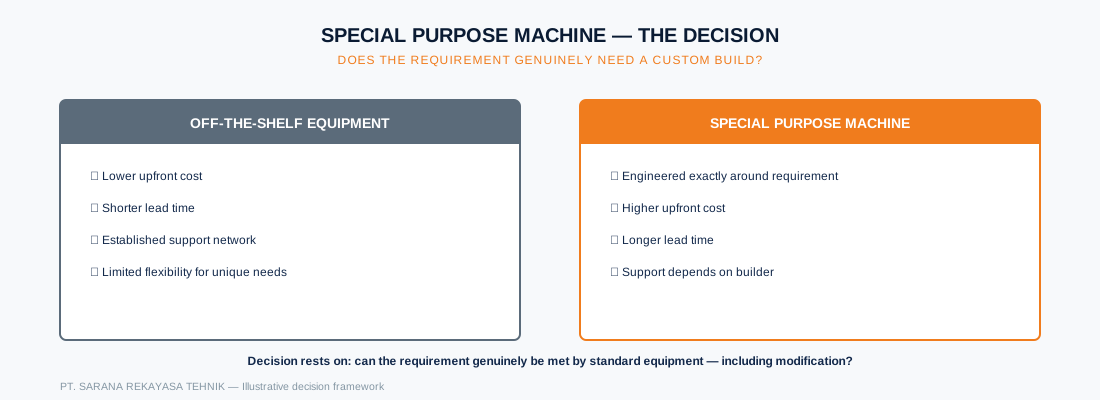
Special Purpose Machine vs. Off-the-Shelf: Decision Comparison
OFF-THE-SHELF EQUIPMENT
- Lower upfront cost, spread across many units sold
- Shorter lead time — often available from stock or short manufacturing runs
- Established manufacturer support and spare parts network
- Limited or no flexibility for non-standard requirements
SPECIAL PURPOSE MACHINE
- Engineered precisely around the actual process requirement
- Higher upfront engineering and build cost
- Longer lead time — design, fabrication, and commissioning
- Support and spare parts depend on the builder's documentation and availability
The Special Purpose Machine Build Process
- Requirement definition. The specific process requirement — part geometry, throughput, sequence, integration points — is documented in detail, forming the engineering basis for the design.
- Concept and mechanical design. Mechanical structure, motion systems, and material flow are designed around the defined requirement, typically with several concept iterations reviewed before finalizing.
- Control and automation design. PLC, servo, and safety system design is developed to match the mechanical design's actual control requirements.
- Fabrication. Structural components are fabricated, and mechanical, electrical, and control systems are assembled.
- Functional testing. The machine is tested against its defined process requirements before being released for installation.
- Installation and commissioning. The machine is installed on-site, integrated with existing systems, and commissioned under monitored, staged conditions.
- Documentation handover. Complete engineering drawings, schematics, bill of materials, and operating documentation are handed over — essential given the absence of an OEM support network.
Special Purpose Machine vs. Retrofit
Where an existing machine is mechanically sound but its control system or process capability has become limiting, a retrofit may address the requirement without a full custom build — modernizing control, automation, or specific mechanical subsystems while retaining the proven structural platform. This is covered in more depth in PLC & Servo Automation Retrofit →. A special purpose machine becomes the appropriate path when no existing platform — standard or retrofit candidate — can reasonably be adapted to the actual requirement.
Risks and Considerations
- Single-source dependency. Spare parts, technical support, and future modifications typically depend on the original builder or their documentation, unlike standard equipment with broader market support.
- Longer lead time risk. Custom engineering and fabrication take longer than sourcing standard equipment, requiring realistic project scheduling.
- Documentation completeness. Incomplete engineering documentation at handover creates long-term maintenance and modification difficulty — this should be a defined deliverable, not an afterthought.
- Requirement drift during design. Changes to the underlying process requirement mid-design can significantly affect cost and timeline — requirement definition should be as complete and stable as practical before design begins.
Industries That Commonly Require Special Purpose Machines
Special purpose machines appear across manufacturing sectors with non-standard process requirements — including specialized assembly and testing equipment in electronics and automotive component manufacturing, custom material handling and forming equipment in food and packaging production, and application-specific fixtures and automation cells across general industrial manufacturing.
Key Takeaways
- A special purpose machine is justified when a process requirement genuinely cannot be met by standard equipment, including reasonable modification.
- The decision should weigh higher upfront cost and longer lead time against the operational cost of an ill-fitting standard machine over its service life.
- Complete engineering documentation at handover is essential, given the absence of an OEM support network for a one-off design.
- Where an existing machine is mechanically sound, retrofit may address the requirement without the cost and lead time of a full custom build.
Have a production requirement that standard equipment can't meet? SRT's engineering team can assess whether a special purpose machine, retrofit, or modified standard equipment is the right fit.
Frequently Asked Questions
What is a special purpose machine?
A special purpose machine is industrial equipment custom-engineered to perform a specific task or process unique to an operation, as distinct from standardized, off-the-shelf equipment designed for general-purpose use.
When should a company consider a special purpose machine instead of off-the-shelf equipment?
When the production process has requirements — geometry, throughput, integration, or handling — that no standard machine on the market meets, or when off-the-shelf equipment would require extensive modification that approaches a custom build in cost and complexity anyway.
Is a special purpose machine more expensive than off-the-shelf equipment?
Typically yes in upfront cost, since design and engineering are specific to one build rather than spread across many units. This should be weighed against the operational cost of an ill-fitting standard machine over its service life, and evaluated case by case.
How long does it take to design and build a special purpose machine?
Timelines vary significantly with complexity, typically ranging from a few months for a straightforward custom fixture or machine to considerably longer for complex, multi-system equipment — engineering design and specification review account for a meaningful portion of this timeline.
What documentation should come with a special purpose machine?
Complete engineering drawings, electrical schematics, a bill of materials, and operating and maintenance documentation — since a special purpose machine has no OEM support network, this documentation is what enables future maintenance, spare part sourcing, and any eventual retrofit.
Related Reading
When modernizing an existing machine is the better path over a custom build.
The broader engineering decision framework for industrial equipment.
How specifications are reconstructed when no documentation exists to build from.
Part of the complete guide: What is Precision Manufacturing? →