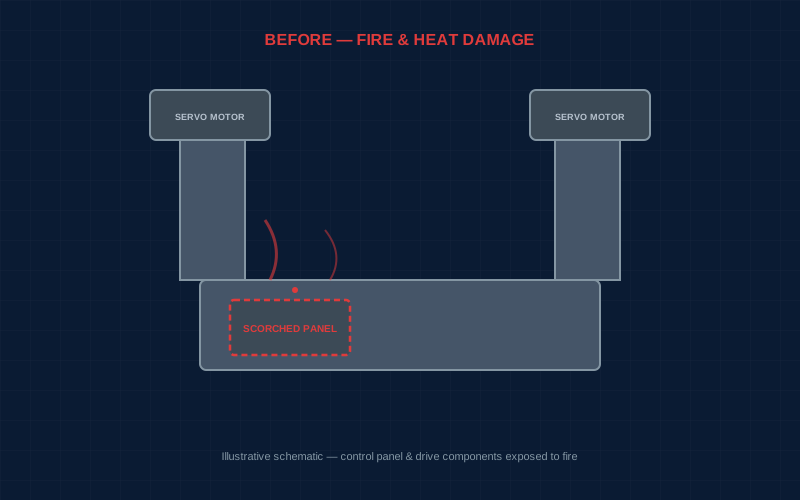
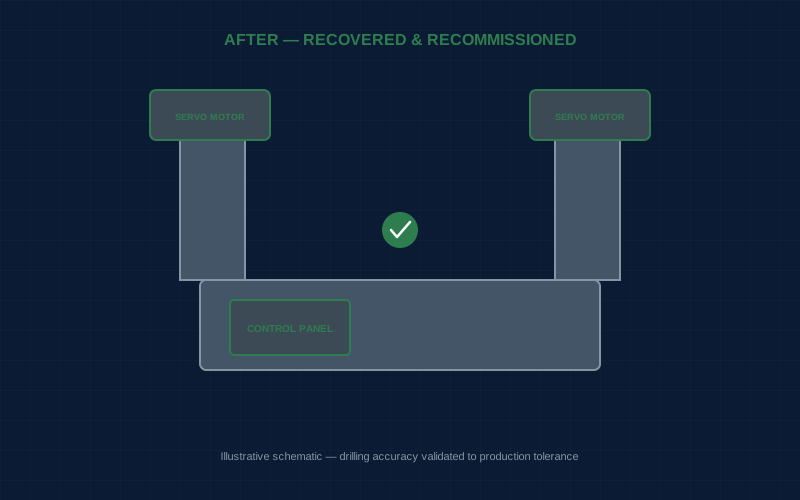
Drag to compare before and after recovery condition (illustrative, anonymized)
FIRE DAMAGE RECOVERY · INDUSTRIAL ASSET RECOVERYA fire-damaged Dual Axis Screw Drilling Equipment, exposed to smoke and heat contamination, was assessed, restored, tested, and safely recommissioned — avoiding the cost and lead time of a full asset replacement.
Project Overview
A Dual Axis Screw Drilling Equipment — an automated precision machine used in electronics manufacturing for fastening operations — sustained fire and smoke exposure affecting its control system, drive components, and structural enclosure. Given the equipment's role in an automated production line, the client faced a consequential decision: pursue a full replacement, or determine through structured engineering assessment whether recovery was technically and economically justified.
SRT was engaged to conduct an independent, evidence-based assessment — applying the same engineering discipline described throughout our knowledge series: what can be recovered, what can be repaired, what must be replaced, and how the complete machine can be safely recommissioned.
The Challenge
Fire and smoke exposure on automated precision equipment presents a distinct engineering challenge compared to simpler machinery: the equipment's value lies substantially in its automation and control system — servo drives, motion controllers, and precision alignment components — which are also the systems most vulnerable to heat and smoke damage. A decision to replace outright would have meant not only the cost of a new asset, but also extended production downtime during procurement and reinstallation.
At the same time, the client could not risk returning a fire-exposed automated machine to production without rigorous validation — precision drilling and fastening operations require both mechanical accuracy and electrical safety that visual inspection alone cannot confirm.
Engineering Methodology
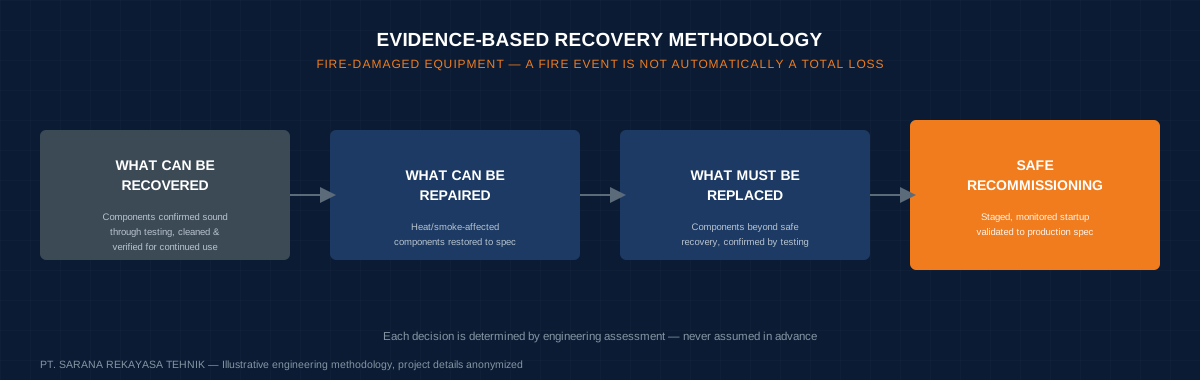
SRT's assessment applied a structured, four-stage decision framework to every affected system of the equipment:
- What can be recovered — components confirmed sound through testing, cleaned and verified for continued use without modification.
- What can be repaired — heat and smoke-affected components restored to original specification through targeted reconditioning.
- What must be replaced — components where testing confirmed damage beyond safe recovery, replaced rather than risked.
- How the complete machine can be safely recommissioned — staged, monitored startup validated against actual production tolerance before full handover.
Assessment Process
| Stage | Activity |
|---|---|
| Safety isolation & documentation | Equipment isolated and as-found condition documented before any cleaning or disassembly |
| Insulation & electrical testing | Insulation resistance testing across control and servo circuits to identify heat-degraded insulation not visible externally |
| Component-by-component evaluation | Servo drives, motion controllers, and control panel components individually tested against functional and safety criteria |
| Mechanical & structural inspection | Verification that heat exposure had not compromised structural alignment critical to drilling precision |
| Recovery Cost Estimation | Itemized, engineering-based cost build-up for the confirmed recovery scope, compared against replacement cost |
Recovery Execution
- Decontamination and cleaning of smoke-affected surfaces and components confirmed recoverable
- Targeted repair and reconditioning of heat-affected control and wiring components
- Replacement of components where testing confirmed damage beyond safe recovery thresholds
- Reassembly and mechanical alignment verification
- Staged commissioning — no-load testing followed by monitored, production-representative trial runs validating drilling accuracy and repeatability
Results
Following assessment, recovery, and staged commissioning, the Dual Axis Screw Drilling Equipment was returned to full production capability with drilling accuracy and repeatability validated against original equipment tolerance. The evidence-based recovery scope — built from confirmed component-level findings rather than a blanket replacement assumption — delivered a cost outcome substantially below the cost of full asset replacement, while avoiding the extended downtime a replacement procurement cycle would have required.
Key Engineering Lessons
- Fire and smoke exposure on automated equipment should never default to a total-loss assumption — component-level assessment frequently reveals a materially different picture than initial visual impression.
- Precision equipment recovery requires validation against actual production tolerance, not just basic functional confirmation, before being considered safely recommissioned.
- Applying the recover/repair/replace framework independently to each subsystem — rather than to the machine as a whole — is what makes significant cost saving achievable without compromising safety or performance.
BURCE Methodology Highlight
This recovery followed SRT's Bottom-Up Engineering Recovery Cost Estimation (BURCE) methodology — building recovery scope and cost from verified component-level evidence, rather than a single equipment-wide estimate. This is the same evidence-based discipline detailed in Bottom-Up Engineering Recovery Cost Estimation: A Systematic Approach → and Beyond Cost Estimation: The SRT RCE Principle →.
Part of the complete guide: What is Machine Recovery? A Complete Guide →
Also read: Fire Damage to Electrical Panels: Recovery or Replace? → and When to Upgrade Legacy PLC/Servo Control Systems →