
When a component is no longer available, or a production requirement calls for equipment that doesn't exist off-the-shelf, precision manufacturing produces it — built to specification, not adapted from a catalog.
Executive Summary. Precision manufacturing for industrial equipment covers precision machining, fabrication, spare part manufacturing, and special purpose machines — producing components and equipment built to exact specification rather than adapted from standard catalog items. This guide explains what each discipline covers, how manufacturing differs from repair, when it's the right path, and how it connects to SRT's broader reverse engineering and recovery capabilities.
What Precision Manufacturing Actually Covers
Manufacturing, in this context, means producing physical components or complete equipment from raw material or a design specification — not repairing something that already exists. It becomes relevant whenever a needed part or machine simply isn't available to purchase as-is, whether because it's obsolete, custom by nature, or produced at a scale too small for standard suppliers to serve economically.
The Core Disciplines Within Manufacturing
Precision Machining. CNC machining to tight tolerances for components where standard manufacturing precision isn't sufficient — critical for parts that must fit or perform within narrow specifications.
Fabrication. Building structures and metal components to engineering specification, from brackets and frames to more complex structural assemblies.
Spare Part Manufacturing. Producing replacement components for machinery that is no longer supported by its original manufacturer — frequently paired with reverse engineering when original specifications no longer exist.
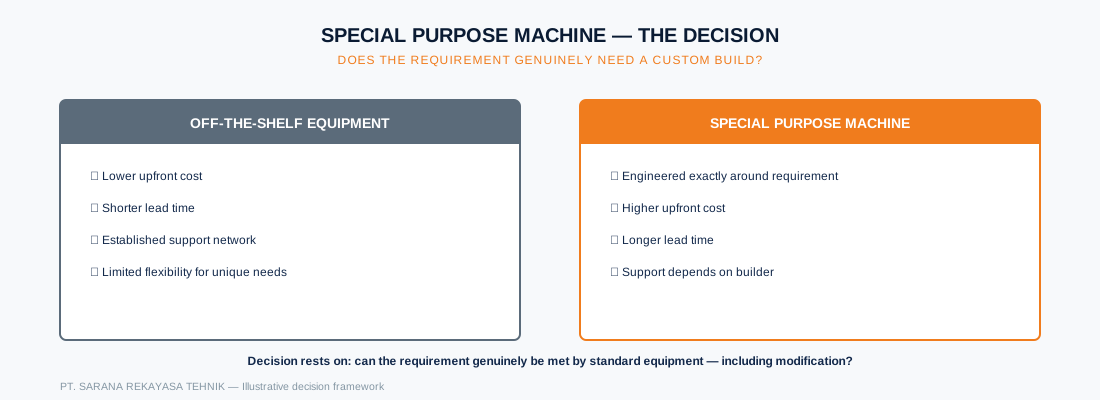
Special Purpose Machine. Designing and building custom machinery for a production requirement that off-the-shelf equipment cannot adequately serve.
Manufacturing vs. Machinery Repair
| Machinery Repair | Manufacturing | |
|---|---|---|
| Subject | An existing, identifiable machine | A component or machine that doesn't yet exist in usable form |
| Typical trigger | A fault has occurred on known equipment | A part is unavailable, or a production need has no standard solution |
| Output | The same machine, restored | A newly produced component or machine |
The two are frequently combined: a machinery recovery project may require manufacturing a replacement component that is no longer available, using specifications established through reverse engineering.
When Manufacturing Is the Right Path
- A required spare part is discontinued and unavailable from the original manufacturer
- A production process has requirements that no standard, catalog machine adequately addresses
- Import lead time or cost for a component makes local manufacturing more practical
- A component requires tolerances or material properties beyond general-purpose parts
Deciding between a special purpose machine and adapting standard equipment specifically deserves its own evaluation — see Special Purpose Machine vs Off-the-Shelf Equipment: How to Decide → for the full decision framework.
How Manufacturing Connects to Reverse Engineering
A significant portion of manufacturing work for industrial clients begins with reverse engineering — reconstructing a component's specifications from a physical sample when no drawings survive. See Reverse Engineering Obsolete Machine Parts → for how this process works before manufacturing begins.
Key Takeaways
- Manufacturing produces components or equipment that don't yet exist in usable form, distinct from repair which restores existing machinery.
- Spare part manufacturing and reverse engineering are frequently paired on the same project.
- A special purpose machine should only be pursued after evaluating whether adapted standard equipment could meet the same need.
- Manufacturing decisions should be grounded in actual production requirements, not assumption.
Frequently Asked Questions
What's the difference between manufacturing and machinery repair?
Manufacturing produces new components or equipment from raw material or design specifications. Machinery repair restores existing equipment to working condition. The two frequently intersect — for example, manufacturing a replacement part is often a step within a larger repair or recovery project.
Do I need a special purpose machine, or would standard equipment work?
This depends on whether your production requirement is genuinely unique or can be met by adapting commercially available equipment. A structured evaluation of process requirements, production volume, and available off-the-shelf options should precede any custom machine decision — see our dedicated guide linked below.
Can obsolete spare parts be manufactured without the original manufacturer?
Yes, this is a common application of reverse engineering combined with manufacturing — reconstructing a component's specifications from the physical part, then producing it through precision machining or fabrication.
What materials can SRT work with?
We work with a range of industrial metals including carbon steel (SS400, S45C), stainless steel (SUS304, SUS316), aluminum (6061, 7075), brass, copper, and other engineering materials, selected based on the component's functional requirements.
Explore the Manufacturing Series
The complete engineering decision framework for custom machinery.
How components are reconstructed before manufacturing begins.
A precision automated component recovered with >60% cost saving over replacement.
The companion guide to design and control system work.
Explore the service: Component Fabrication & Manufacturing →