
When the manufacturer is gone and the drawings never existed, the physical part itself becomes the only reliable source of engineering truth.
Executive Summary. Reverse engineering reconstructs a component's geometry, tolerances, and material specification directly from the physical part, applied when original design documentation is incomplete, obsolete, or simply unavailable. This is a common requirement in industrial machine recovery and retrofit work, where legacy equipment frequently outlives both its manufacturer and its original engineering records. This guide covers when reverse engineering is genuinely necessary, the process and techniques involved, and the considerations — accuracy, material verification, and documentation completeness — that determine whether the result is fit for purpose.
What Reverse Engineering Means in an Industrial Context
Reverse engineering, in this context, is the process of reconstructing a component's dimensional geometry, tolerances, and material specification by direct examination and measurement of the physical part — working backward from the object to the engineering documentation that describes it, rather than forward from documentation to object as in conventional design.
This is distinct from reverse engineering in a software or competitive-analysis sense; here, the objective is almost always practical: enabling repair, remanufacture, or fabrication of a component that can no longer be sourced or documented through its original manufacturer.
When Reverse Engineering Is Genuinely Necessary
| Situation | Why Reverse Engineering Applies |
|---|---|
| Original manufacturer no longer exists or supports the part | No source remains for OEM drawings, specifications, or replacement stock |
| Engineering drawings were lost or never existed | Common with older equipment, especially where documentation wasn't retained through ownership changes |
| The component has been modified from its original design | Field modifications over the years may mean even original drawings, if available, no longer reflect actual as-built condition |
| A replacement is needed faster than OEM lead time allows | Reverse engineering can support in-house or third-party fabrication where OEM sourcing would cause extended downtime |
The Reverse Engineering Process
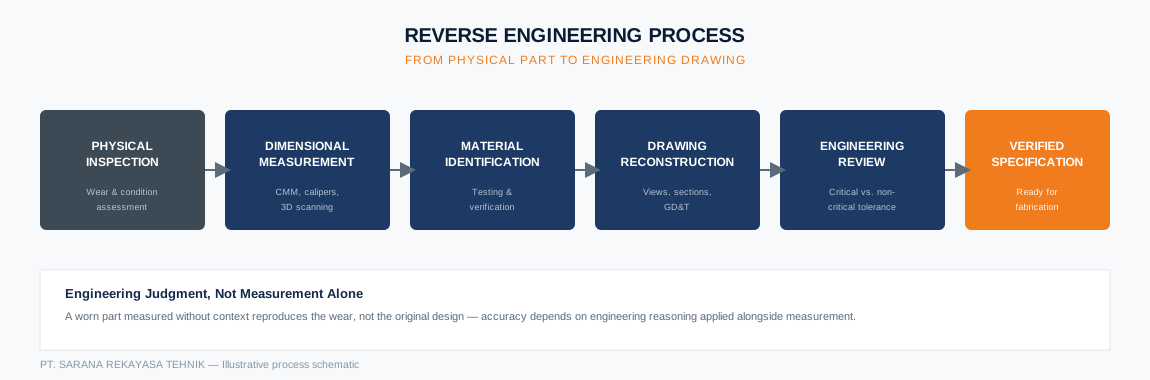
- Physical inspection and condition assessment. The reference part is examined for wear, damage, or prior modification that could affect measurement accuracy — a worn part measured without this context risks reproducing the wear, not the original design intent.
- Dimensional measurement. Precise measurement of the part's geometry using appropriate tools — calipers, micrometers, coordinate measuring machines (CMM), or 3D scanning depending on complexity and required accuracy.
- Material identification. Determining the part's material composition and properties, through visual/contextual assessment, testing, or reference to comparable known applications, since material selection significantly affects part performance and cannot be reliably assumed.
- Engineering drawing reconstruction. Measured data is translated into a complete engineering drawing — orthographic views, sections, dimensions, and geometric dimensioning and tolerancing (GD&T) — not simply a 3D scan file.
- Engineering review and tolerance judgment. Raw measurements are reviewed against engineering reasoning: which dimensions are functionally critical and require tight tolerance, and which reflect normal manufacturing variation that shouldn't be over-specified.
- Verification. Where practical, the resulting drawing or a test fabrication is verified against fit, function, or a second reference sample before being finalized for production use.
Measurement Techniques by Application
- Manual measurement (calipers, micrometers, gauges) — suitable for simple geometries with moderate tolerance requirements.
- Coordinate Measuring Machine (CMM) — used for complex geometries or tight-tolerance components requiring high measurement precision.
- 3D scanning — efficient for capturing complex or organic surface geometry, though scanned data typically requires engineering interpretation to produce a properly toleranced drawing rather than a raw point cloud.
- Material testing — where material composition is uncertain and functionally significant, testing may be warranted rather than assumption based on visual similarity to known materials.
Common Risks and How They're Managed
Risks that reduce reverse engineering accuracy if not addressed:
- Measuring a worn or damaged part without accounting for wear in the final dimensions
- Assuming material properties without verification, on a functionally critical component
- Over-tolerancing every dimension equally, rather than distinguishing functionally critical dimensions from non-critical ones
- Relying on a single reference sample when only one — potentially non-representative — part is available
These risks are managed through engineering judgment applied alongside measurement — not through measurement precision alone. This is why reverse engineering is treated as an engineering exercise, not simply a scanning or measurement service.
Legal and Intellectual Property Considerations
Reverse engineering for internal maintenance and repair purposes is generally treated differently from reproducing a design for commercial resale, and intellectual property considerations can vary meaningfully by jurisdiction and specific circumstances. This is a legal question outside the scope of engineering assessment — where reverse engineering intersects with active patents, licensing agreements, or commercial reproduction, independent legal review is warranted before proceeding.
Reverse Engineering and Machine Recovery
Reverse engineering frequently supports broader machine recovery and retrofit work — reconstructing a component's specification so that recovery, retrofit, or special purpose fabrication can proceed without OEM documentation. This connects directly to What is Machine Recovery? A Complete Guide → and Special Purpose Machine vs Off-the-Shelf Equipment →, where reverse-engineered specifications often form the technical basis for a custom-fabricated replacement part.
Deliverables From a Reverse Engineering Project
A complete reverse engineering deliverable typically includes: a fully dimensioned and toleranced engineering drawing (orthographic views, sections, GD&T where relevant), material specification, and where applicable, a 3D model suitable for CAM/manufacturing use. Documentation quality matters as much as measurement accuracy — a drawing missing tolerance information or material specification leaves ambiguity that a fabricator must guess at, undermining the purpose of the exercise.
Key Takeaways
- Reverse engineering is a considered decision for when documentation or OEM sourcing is genuinely unavailable — not a default first option.
- Accuracy depends on engineering judgment applied to measurement, not measurement precision alone — worn parts and unverified materials are common sources of error.
- Complete documentation (drawing, tolerances, material spec) is the actual deliverable — not just a scan or a set of raw dimensions.
- Legal and intellectual property considerations exist outside engineering scope and should be reviewed independently where relevant.
Need to reconstruct specifications for an obsolete or undocumented machine component? SRT's engineering team can conduct reverse engineering to support repair, remanufacture, or fabrication.
Frequently Asked Questions
What is reverse engineering in an industrial context?
Reverse engineering is the process of reconstructing a component's geometry, tolerances, and material specification directly from the physical part, used when original design documentation is incomplete, obsolete, or unavailable.
When is reverse engineering necessary for machine parts?
When a component's original manufacturer no longer supports it, original engineering drawings are lost or incomplete, or a replacement part must be sourced or fabricated without access to OEM specifications.
How accurate is a reverse-engineered part compared to the original?
Accuracy depends on the measurement method and the condition of the reference part — a worn or damaged original can introduce error if not accounted for, which is why dimensional inspection and engineering judgment are applied together, not measurement alone.
Are there legal considerations in reverse engineering machine parts?
Reverse engineering for maintenance and repair purposes is generally distinct from reproducing a design for commercial resale, and intellectual property considerations can vary by jurisdiction and specific circumstances — this is a legal question outside the scope of engineering assessment and should be reviewed independently where relevant.
What deliverables come from a reverse engineering project?
Typically a complete engineering drawing with dimensions and tolerances, material specification, and where relevant, a 3D model — sufficient documentation to fabricate, inspect, or further modify the component.
Related Reading
The broader recovery framework reverse engineering often supports.
Where reverse-engineered specifications inform custom fabrication.
Part of the complete guide: What is Machine Recovery? A Complete Guide →
Also part of: What is Industrial Automation Engineering? → and What is Precision Manufacturing? →